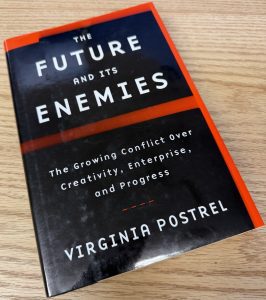
What does it take for societies to adapt, innovate, and remain resilient over time? In The Future and Its Enemies, Virginia Postrel explores the tension between openness and control—and why tolerance, patience, and criticism are essential to long-term progress.
Tolerance, Criticism, and the Dynamics of Progress
Tolerance demands toughness. It means accepting that we cannot always have things our own way and that we must not limit our neighbors’ experiments, aspirations, or ideas just because they might make us feel bad. As Jonathan Rauch notes in Kindly Inquisitors, those who believe in the dynamic process of intellectual inquiry, which he calls “liberal science,” must endure the discomfort that comes along with criticism. Inquiry is a competitive, trial-and-error system that requires not only experiments but sometimes brutally frank feedback: “Those of us who hold sacred the right to err and the duty to check need to understand that our defense of liberal science must preach not only toleration but discipline: the hard self-discipline which requires us to live with offense.” Maintaining society’s “youthful vitality” requires both tolerance and a thick skin.
It also requires patience. Dynamists avoid panic in the face of new ideas. They realize that people get used to new developments, that they adjust-the two-story house next door turns out to be no big deal and that they often reject bad ideas without any centralized, official response. The critic Martha Bayles, whose writings on popular music reflect fairly conservative tastes, takes a dynamist approach to culture, including cultural developments she dislikes. She believes in informed criticism, and plenty of it. But she is patient. Criticism, she suggests, should not be a prelude to censorship but part of an ongoing, dynamic process. “Built into the wise use of cultural authority is an appreciation of the process of learning,” she says. “It is vital to remember that learning, and self-correction, are constantly occurring within popular culture …. In the end, it is this patient work of criticism, self-correction, and teaching that is most imperiled by censorship.” Bayles’s approach is not just a matter of policy-censorship versus free speech-but of process. Rather than looking for short-cuts that will make art turn out exactly the way she envisions it, she values the give and take that deepens cultural understanding.
For planners and community leaders, this idea has practical implications. Whether in rural development, education systems, or civic infrastructure, progress rarely comes from control alone. It emerges from experimentation, feedback, and the willingness to tolerate outcomes that may not align with initial expectations. The challenge is not to eliminate friction, but to create systems that can learn from it.
JCShepard(dot)com
In April, we are looking at Community Facilities, including historic sties and educational infrastructure, as part of the Comprehensive Plan process. I will also be participating in the American Planning Association’s annual National Planning Conference. This year #NPC26 is in Detroit, Michigan.
When rural communities face big challenges, they often turn to their greatest strength: each other. Across the United States and Canada, small towns are not just exchanging ideas—they’re creating policy that works. From cross-sector partnerships and locally led innovation to smart governance reform, rural America is building solutions grounded in collaboration, flexibility, and place-based leadership….
Detroit is a city that is moving from surviving the rust belt to showing resilience to rebuild for the future. For a few spring days this week, more than 4,000 planners and community volunteers descended on this river town for the American Planning Association’s National Planning Conference—#NPC26—turning downtown Detroit into a temporary campus for people…
This is Part Three in our series on Conservation and the Great Outdoors: Exploring how small towns and gateway communities are building sustainable outdoor economies that serve both people and place. As outdoor recreation grows in popularity across the U.S., small towns near natural landmarks face both new opportunities and familiar pressures. The promise of…
Over the past month, we’ve explored what makes rural economies resilient. From the diverse economic base beyond agriculture, to the importance of retaining and expanding local businesses, to the rise of entrepreneurship and micro-enterprises, and most recently, to the role of innovation and community-driven development—each article has shown that resilience is never the result of…
May 2026 Series Preview April’s series asked what it takes to keep the physical foundations of rural community life strong—civic buildings, historic structures, and education systems working together as a system rather than in isolation. May takes that same question outdoors. This month, we explore how rural counties use comprehensive planning to build healthier, more…

 Watch the full replay: youtube.com/@Engaging-Communities (February 2026)