
Solar Energy, Farmland, and the Agrivoltaic Frontier
How Rural America Is Blending Clean Energy, Agriculture, and Ecological Resilience
This is the third installment in JCShepard.com’s October energy series, examining how the clean energy transition is transforming rural communities. In Week 1, we explored global energy trends and the rising strain on rural grids. Last week, we focused on wind energy and how rural zoning is being reshaped by wildlife protections, battery storage, and community values.
This week, we dig into the rapidly evolving world of solar energy in agricultural landscapes—and how innovations like agrivoltaics are helping communities turn potential conflicts into shared opportunities.
Rural solar development has often sparked controversy—over land use, aesthetics, or the loss of agricultural productivity. But as panels become more flexible, zoning becomes smarter, and farmers seek more stable revenue, a new model is emerging: dual-use systems that allow land to grow food, support biodiversity, and generate clean energy all at once.
From Colorado’s Jack’s Solar Garden to Vermont’s floating permits and Minnesota’s pollinator scorecards, agrivoltaics is moving from pilot project to practical policy. But success depends not just on technology—it depends on planning, partnerships, and a new way of thinking about land.
Let’s explore how solar and farming can not only coexist—but thrive together.

Solar’s Rural Surge — But Not Without Friction
Solar development is booming. Utility-scale solar farms now dot landscapes across North America, generating clean electricity while introducing a new layer of land use complexity.
Globaly, nations generating the highest share of their electricity from solar power in 2025 are predominantly smaller European countries with aggressive renewable targets. While China, the US, and India lead in sheer installed capacity, it is countries like Chile, the Netherlands, Australia, and Spain that are global leaders for the share of national electricity generated by solar power. As of mid-2025, Australia has installed over 41.8 GW of solar photovoltaic (PV) capacity from more than 4.16 million separate installations—more than any other country per capita.
Solar energy generation is rapidly expanding in North America, playing an increasingly significant role in each country’s renewable energy portfolio. While the US is a global leader in solar installations, Canada is growing steadily with ambitious targets and supportive policies driving adoption.
The United States has been experiencing record-breaking growth in solar energy generation. In the first half of 2025, developers added 12 gigawatts (GW) of new utility-scale solar capacity, with an additional 21 GW planned for the second half of the year. If all planned additions are realized, solar will account for more than half of the total 64 GW of new electricity generating capacity brought online in 2025, outpacing all other energy sources. California, Texas, and Florida are leading the nation. California also produces the highest percentage of its electricity from solar, approaching one-third of all power consumed in the state. Nevada, Massachusetts, and Vermont are notable for their high solar penetration relative to total state electricity demand.
Canada’s solar energy sector is also growing quickly. As of 2025, Canada has about 2.3 GW of utility-scale solar energy capacity The nation generated around 4,323 gigawatt-hours (GWh) of solar electricity in 2022, enough to power over 470,000 homes. Remarkably, 70% of new electricity capacity between 2025 and 2050 is expected to come from wind, solar, and battery storage, according to recent forecasts. Ontario and Alberta have the largest installed solar energy capacity.
Solar leases provide a stable income stream for landowners, often offsetting the financial volatility that comes with traditional farming. Communities also benefit from local and state tax revenues generated by solar projects—about $739 million returned to rural areas across the US via such sources last year. However, rapid solar development has provoked resistance in some rural counties: 15% of US counties have adopted some form of restriction or outright ban on new utility-scale solar projects so far.

Solar Sparking Concerns
Unlike wind turbines, which occupy relatively little land per megawatt, solar projects require extensive acreage. As an American Farm Bureau Federation briefing noted, “The same traits that make specific plots of land good for farming can also make them a prime candidate for utility-scale solar.” That can spark concerns about farmland loss, rural character, and unclear regulations. But there is hope: more and more communities are discovering that solar energy and agriculture can enhance one another, with co-use models like agrivoltaics offering new income streams, improved land resilience, and added biodiversity.
Still, friction remains.
- Between 2009 and 2020, nearly 64% of US solar projects were built on agricultural land previously used for crops, pasture, or rangeland. About 83% of projected new solar installations by 2040 are expected to be sited on agricultural land.
- Solar facilities directly remove wildlife habitat and can create fragmentation effects that extend beyond facility boundaries.
- A “lake effect” can attract certain water-associated bird species when solar panels polarize reflected sunlight in patterns consistent with natural water bodies.
- “Silent” zoning ordinances — local rules that simply don’t mention solar — have effectively blocked energy development.
- This patchwork of permitting uncertainty, excessive setbacks, and vague definitions is now driving up project costs by an estimated $4.8 billion nationwide. For rural communities, that means fewer competitive bids, delayed infrastructure upgrades, and lost lease income for landowners who might otherwise benefit from hosting solar.
Author and farmer Rebekah Pierce describes overcoming this friction in her forthcoming book Agri-Energy:
It’s easy to reject a faceless entity, a solar farm built on your neighbor’s property and absorbing your entire viewshed… Those are ugly, industrial things, put in place by out-of-towners who don’t know your community well at all or have its best interests in mind.
But what about when those installations directly benefit local farmers? What about the trickle-down effect that happens when money is being spent locally and power is being generated in your own town to electrify you own homes an businesses?”
As the Farm Bureau briefing continued, “Private property rights advocates lean heavily toward allowing landowners to use their land for whatever the market will pay for, however, there are robust policy discussions as to on what government assistance for renewable energy should look like.” The stakes are high: either rural counties shape solar development proactively — or risk being sidelined as investors move to more predictable jurisdictions.

Zoning: The Unsung Barrier to Rural Solar
Despite the growing promise of agrivoltaics and other dual-use solar innovations, zoning remains one of the most significant—and often overlooked—obstacles to solar adoption in rural communities. Across the country, local regulations have struggled to keep pace with rapid changes in technology, land use, and energy economics.
In many rural counties, solar projects face a regulatory environment that is unclear at best—and actively discouraging at worst. Common issues include:
- Missing ordinance language: Many counties have no clear definitions or permitting pathways for ground-mounted solar, leaving planners, landowners, and developers in legal limbo. In legal principles of zoning regulation, what is not specifically permitted is typically prohibited.
- Restrictive dimensional standards: Setbacks of 50 to 100 feet or greater, and height limits of 15–20 feet or less, are common. This can severely constrain system layout—especially for agrivoltaic projects which require elevated panels or wider row spacing.
- Incompatible visual requirements: Mandated fencing or vegetative screening can conflict with intended co-uses such as grazing or pollinator habitat, undermining ecological benefits and driving up costs.
- Zoning district exclusions: In some areas, solar is outright prohibited in agricultural zones, allowed only in industrial or commercial districts—effectively excluding the very farmland best suited for agrivoltaic integration.
- Lengthy approval processes: Even modest systems often require conditional use permits (CUPs), triggering public hearings, environmental reviews, and delays that add months and tens of thousands of dollars in soft costs.
Here in the Midwest, County solar zoning tends to fall into one of three categories.
- Basic Zoning Standards: Roof-top solar (eligible for net metering) is a typical accessory structure and may be exempt from zoning. Utility scale solar facility must meet the same setbacks as any other accessory structure like a garage.
- Average Zoning Standards: Roof-top/home-based solar (net metering) by simple zoning permit. Commercial-utility scale solar facility reviewed by Conditional Use Permit and must meet standard setbacks for a principal use like a barn, although may require up to 50′ from homes. Height may be limited to about 25′ to reduce visual impacts.
- Restrictive Zoning Standards: Extensive application requirements for all types of solar panels and generation facilities. 75′ to 100′ foot setbacks from roads and property lines, 1/4 mile to 1/2 mile or farther to dwellings, churches, schools, parks, villages. Maximum 12′ to 15′ height.
This fragmented regulatory landscape creates uncertainty for investors, who may opt to skip over counties with unclear or inconsistent ordinances in favor of jurisdictions with streamlined, predictable permitting. For local landowners, it can mean missed opportunities, while also stoking conflict with neighbors who may oppose solar on visual or cultural grounds.
The result is too often a zero-sum game: energy vs. agriculture, neighbors vs. landowners, growth vs. preservation.
But it doesn’t have to be this way. With proactive planning, inclusive dialogue, and flexible ordinance design, rural communities can create zoning frameworks that balance local values with clean energy opportunities—and turn solar from a flashpoint into a foundation for shared prosperity.

Agrivoltaics: Energy and Agriculture, Together
What Is Agrivoltaics?
Agrivoltaics — or dual-use solar — is the practice of combining solar energy production with agriculture on the same land.
Picture this: rows of solar panels towering above a field of grazing sheep, or blueberry bushes thriving in the dappled shade beneath photovoltaic arrays. In Japan, solar panels float above fish ponds; in Massachusetts, cranberry bogs and solar arrays coexist; in California, solar panels cover irrigation canals. This isn’t futuristic thinking — it’s happening now.
Across the U.S., hundreds of agrivoltaic projects are already operational, with new demonstration sites launching each season. The U.S. Department of Energy’s Solar Energy Technologies Office reports over 2.8 GW of agrivoltaic capacity installed or in development, driven by growing interest from farmers, state agencies, and conservationists alike. Farmers can access new income from leasing land for solar while also potentially increasing yields and quality for shade-tolerant crops or grazing animals like sheep and cattle.
Why It Matters for Rural America
Agrivoltaics bridges the gap between clean energy and rural livelihoods. It’s a win-win for farmers, ecosystems, and the climate:
- Economic resilience: Solar leases can pay $500–1,000+ per acre annually — a game-changer compared to traditional agricultural leases, which often fall below $100/acre. “For us, agrivoltaics meant the difference between selling the farm and expanding it,” says John Hayes, a fifth-generation farmer in Oregon who now grazes sheep under solar panels.
- Climate adaptation: Research from the University of Arizona shows that partial shading from panels can reduce water evaporation by up to 30%, while protecting crops like tomatoes and lettuce from heat stress. In drought-prone regions, this can mean the difference between a failed harvest and a bumper crop.
- Biodiversity boosts: Projects like Minnesota’s “Solar for Pollinators” initiative have demonstrated that solar sites with native plantings can increase pollinator populations by 20–50%, directly benefiting nearby crops like almonds and apples.
- Workforce opportunities: From solar technicians to agrivoltaic crop specialists, these projects create local jobs — often in areas where youth outmigration is a pressing issue.
- Minimal land impact: Even under ambitious solar expansion, studies project that less than 3% of Midwest prime farmland would be needed by 2050 — a fraction of what’s lost to urban sprawl or soil degradation each year.
Challenges remain, of course. Upfront costs and complex zoning laws can slow adoption. But with federal grants (like the USDA’s Agrivoltaics Research Program) and innovative financing models, the barriers are falling fast.
Agrivoltaics aligns clean energy with rural values — stewardship, productivity, and resilience. As solar farms become a fixture of the American landscape, this approach ensures that the land doesn’t just power our homes, but also nourishes our communities, protects our soil, and sustains our rural way of life. The question isn’t if agrivoltaics will shape the future of farming, but how quickly we can scale it up.

Smart Planning for Solar and Farmland
If rural communities want to shape solar development—rather than simply react to it—they need zoning frameworks that are clear, flexible, and rooted in local land values. Fortunately, the tools exist. With thoughtful updates to zoning codes, counties can transform solar from a perceived land-use conflict into a well-integrated feature of the working landscape.
Proactive Zoning Can Do Three Things Well:
1. Define Agrivoltaics Clearly
Without a legal definition, “agrivoltaics” can become a vague buzzword—used loosely by developers without real agricultural integration. Local ordinances should establish:
- What counts as agrivoltaics (e.g. solar grazing, row cropping, pollinator habitat)
- How agricultural activity will be demonstrated and maintained over time
- What conditions must be met for continued dual-use eligibility
This not only prevents greenwashing but ensures that rural land remains productive and accessible, even as it contributes to clean energy goals.
2. Streamline Permitting with Tiered Pathways
One-size-fits-all permitting doesn’t serve anyone. A better approach uses tiered review based on project scale, site context, or zoning district:
- Small-scale or on-farm systems (e.g. <5 acres or <1 MW) might be exempted from zoning, or permitted “by right” in agricultural zones with only basic administrative review.
- Mid-sized projects could require staff-level site plan approval with defined design criteria.
- Large utility-scale solar may undergo conditional use permitting—but only if clearly mapped criteria (such as proximity to prime soils or ecological buffers) trigger that review.
This structure provides predictability for developers, while giving local officials appropriate oversight based on project impact.
3. Encourage Performance-Based Design
Instead of relying solely on static requirements like setbacks or screening, zoning codes can incentivize or reward solar projects that deliver measurable local benefits. For example:
- Bonus density or expedited review for including native pollinator habitat
- Reduced setbacks if grazing or row cropping is planned and documented
- Fee reductions for soil protection measures or stormwater best practices
Performance-based zoning shifts the conversation from “whether” to “how well”—allowing projects to be judged on their contribution to rural resilience, not just their footprint.
County Innovation in Action
Some communities aren’t waiting. Across the U.S., rural counties are quietly testing smarter models:
- Boulder County, Colorado allows solar in agricultural zones through performance-based criteria that support dual-use farming and ecological design. The county’s code encourages collaboration with agricultural tenants during project planning.
- Monterey County, California requires detailed habitat or crop compatibility plans for solar on farmland—helping ensure that energy and food production aren’t at odds.
- Chittenden County, Vermont is piloting a novel “floating CUP” model, where projects are evaluated on both energy contribution and agricultural value, reducing regulatory friction while maintaining rural land priorities.
At the state level, leadership is also growing:
- Massachusetts offers higher solar incentives for dual-use systems through its SMART program, provided farms maintain active agricultural production.
- Minnesota supports pollinator-friendly solar through a statewide scorecard system used in permitting and procurement.
- Illinois requires developers seeking tax credits for farmland-based solar to show how agricultural productivity will be preserved or restored.
These examples show that flexible, adaptive zoning isn’t just possible—it’s already happening.

Designing for Dual-Use: Making Agrivoltaics Work on the Ground
A successful agrivoltaic project isn’t just a solar farm with a few sheep grazing underneath—it’s a carefully engineered system that aligns with the rhythms, requirements, and realities of working farmland. True dual-use design blends energy infrastructure with agricultural utility, ensuring that neither function is compromised.
As Rebekah Pierce describes in her book, there are different models of solar energy development works on the ground. In the common model, farmers lead their land to developers and the land goes dormant. For some projects, the energy developer may choose a third party to come in and farm the land, often grazing sheep or other small animals in lieu of mowing grass. There are also some brave farmers installing their own renewables, supplying their own on-farm energy needs and often selling power commercially back onto the grid while continuing to farm the ground.
Here’s what that looks like in practice:
Elevated Racking Systems
Standard solar arrays often sit just 2–4 feet above the ground—too low for any meaningful agricultural use. Agrivoltaic systems typically use higher racking, with the bottom of panels ranging from 4-6 feet for grazing to 10–14 feet or more to accommodate fruit trees, or tractors and other farm equipment. This allows for inter-row tillage, planting, and harvesting without damaging panels or restricting operations. This often puts the very top of the solar panels higher than zoning allows.
Wider Row Spacing and Flexible Panel Orientation
Dual-use requires more than just vertical clearance. Wider spacing between panel rows ensures that sunlight reaches crops and allows for natural ventilation to reduce moisture-related disease. Some systems use tracking technology that shifts panels during the day—helping optimize both energy production and solar access for plants.
Adaptive Land Management Practices
Agrivoltaics thrives when land use practices are tied to the local agricultural context. That might include:
- Rotational grazing plans with specific stocking rates, fencing strategies, and rest cycles
- Seasonal planting schedules that match solar production curves or shade tolerance
- Use of low-impact machinery or manual labor to reduce soil compaction under arrays
These approaches support both agricultural productivity and long-term land health.
Pollinator-Friendly Groundcover and Ecological Integration
Planting native grasses and wildflowers beneath and around solar arrays serves multiple functions:
- Erosion control and improved stormwater infiltration
- Habitat restoration for pollinators, birds, and beneficial insects
- Carbon sequestration and soil regeneration
Several states, including Minnesota and Maryland, now include pollinator-friendly certification for solar projects—offering public recognition and sometimes permitting advantages.
Transparent and Farmer-Centered Lease Agreements
Strong agrivoltaic design isn’t just physical—it’s legal. Lease terms should clearly outline:
- Access rights for farmers, ranchers, or third-party grazers
- Land management responsibilities (e.g. weed control, reseeding, fencing maintenance)
- Revenue sharing or co-benefit structures between energy developers and agricultural operators
Transparent agreements reduce conflicts and create long-term alignment between energy and agricultural goals.

Building the Knowledge Base: Research and Field Trials
As agrivoltaics grows from pilot projects to mainstream practice, a wide range of institutions are testing what works:
The US Department of Energy (DOE) provides substantial funding and leadership for the InSPIRE project—Innovative Solar Practices Integrated with Rural Economies and Ecosystems—which advances research and deployment of “agrivoltaics,” or the integration of solar development with agriculture and ecological stewardship. The project is managed by the National Renewable Energy Laboratory (NREL) and is supported by the DOE’s Solar Energy Technologies Office.
DOE support enables InSPIRE to:
- Conduct field and analytical research at over 30 test sites across the US.
- Explore the operational and environmental compatibility of co-locating solar panels with grazing animals, crop production, pollinator habitats, and greenhouses.
- Generate foundational data, best practices, and tools for stakeholders involved in solar and agricultural land use.
- Offer technical assistance to solar developers, farmers, and landowners.
- Engage communities and support equitable participation in solar-agricultural projects, including outreach to farmers of color.
InSPIRE combines coordinated, peer-reviewed research methodologies across sites to ensure quality and comparability of results. Its work helps reduce the siting conflicts between solar and agricultural or conservation land, provides data for cost-benefit analyses, and supports scalable solutions nationwide. The project’s outreach extends into its Agrivoltaics Map, financial calculators, policy guidance, and a library of case studies.
Case Study: Jack’s Solar Garden – A Living Lab for Agrivoltaics
Location: Longmont, Colorado
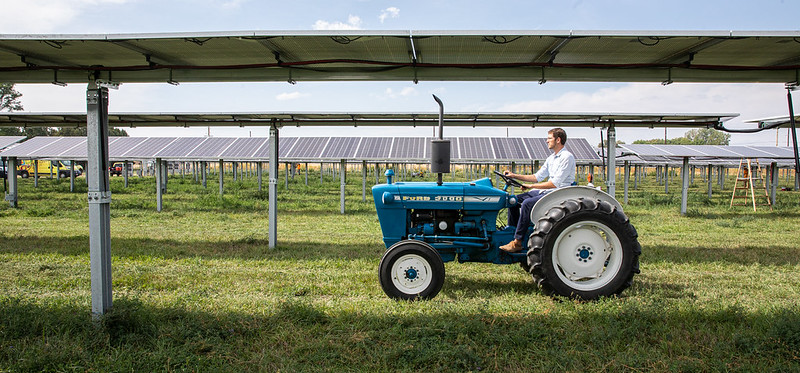
Scale: 1.2 MW | 3,276 panels | 5-acre solar array on a 24-acre farm
Output: Enough to power 300+ homes
Website: www.jackssolargarden.com
Jack’s Solar Garden is widely regarded as the most comprehensive agrivoltaic case study in the United States. With its deep integration of agriculture, energy production, research, and community outreach, the project offers a powerful real-world model for how rural land can serve multiple functions—simultaneously advancing clean energy, food production, ecological restoration, and local economies.
1. Project Overview & Partnerships
The project is owned and operated by the Kominek family and located just outside Longmont, Colorado, on what was previously a small hay farm. Facing economic and environmental pressure, the family transformed a portion of the property into a solar farm—without abandoning its agricultural roots.
Key Collaborators:
- Research: National Renewable Energy Laboratory (NREL), Colorado State University, University of Arizona
- Agriculture: Sprout City Farms (primary grower), local herders (grazing management)
- Ecology: Audubon Rockies (pollinator habitat)
- Education: Colorado Agrivoltaic Learning Center (CALC) — provides school tours, farmer workshops, and field training programs
Mission: To explore how co-locating solar and agriculture impacts crop yields, soil moisture, pollinator presence, and the economic viability of dual-use land strategies.
2. Agrivoltaic Innovations in Practice
Crops & Cultivation
A wide range of crops are grown between and beneath the solar panels, including:
- Tomatoes, cucumbers, beans, lettuce, basil, berries, corn, and flowering plants for pollinators
These are not symbolic test rows—they’re part of a robust farm operation supplying local markets. Operator Byron Kominek has found great success with perennial berry pushes, which thrive in the protected shade of the solar panels.
Key techniques include:
- Microclimate management: The panels provide partial shade that creates cooler, more humid microzones—ideal for crops sensitive to heat and UV stress.
- Irrigation efficiency: Research shows crops under the panels require 15–50% less water due to reduced evaporation and improved soil moisture retention.
- Pollinator integration: Over 3,000 native plant species were seeded by Audubon Rockies, resulting in four times the pollinator activity compared to adjacent fields—boosting both crop resilience and regional biodiversity.
Grazing & Soil Health
- Sheep grazing is used for natural vegetation control, reducing the need for mechanical mowing and supporting local ranching.
- Soil monitoring reveals higher carbon sequestration, lower erosion rates, and 15% higher soil moisture under the panels—contributing to both environmental and yield benefits.
3. Research Insights & Measured Impact
Crop Performance
- Tomatoes & cucumbers: Grew better and yielded more under panels, thanks to temperature moderation and UV filtering.
- Herbs & berries: Showed stronger color, aroma, and flavor profiles due to reduced water stress.
- Challenges: Some crops (like pumpkins) suffered early fungal issues due to condensation under panels, but this was resolved by adjusting planting distance from panel edges.
Water Conservation
In drought-prone Colorado, water use is a critical metric. Agrivoltaic rows required up to 50% less irrigation, dramatically reducing demand in peak summer months—a major advantage for future resilience.
Energy & Climate Benefits
- Panels operate cooler due to plant transpiration and shade—leading to a 3% increase in energy output during hot months.
- If scaled nationally, agrivoltaics modeled after Jack’s Solar Garden could reduce U.S. agricultural carbon emissions by an estimated 330,000 tons of CO₂ annually.
Economic Model
- The Kominek family earns revenue from three streams: solar lease payments, diversified crop sales, and educational programming.
- Farmers typically earn $500–$1,000 per acre per year from solar leases—well above the $100–$150/acre average for traditional farmland rents in the region.
- The project has generated new jobs in farm operations, maintenance, education, and research support—offering a replicable model for rural employment diversification.
4. Education & Community Engagement
Jack’s Solar Garden is as much a classroom as it is a farm. In 2021 alone, the site hosted:
- 500+ educational visitors, including school groups, farmers, planners, and energy professionals
- Workshops and field labs on irrigation, grazing management, and pollinator ecology
- Community arts programming, including local art installations and annual fellowships for creatives exploring land, food, and energy themes
The project also played a pivotal advocacy role. It helped inform the passage of Colorado Senate Bill 092 (2023)—officially recognizing agrivoltaics in state energy and agriculture policy and unlocking new research and grant funding.
5. Scaling Up: From Showcase to Blueprint
While the solar portion of Jack’s Solar Garden spans five acres, the remaining 19 acres are now being converted into agroforestry—combining tree crops, grazing, and perennial agriculture in harmony with the energy infrastructure.
The site’s data and lessons are being used by:
- NREL to model dual-use energy/agriculture potential across the U.S.
- State agencies and extension services to develop agrivoltaic guidance
- Planners and zoning officials looking to update local ordinances based on real-world outcomes
Why Jack’s Solar Garden Matters
Jack’s Solar Garden demonstrates that with intentional design, community partnerships, and adaptive management, rural solar can deliver a “triple win”:
- Clean energy generation aligned with climate goals
- Viable agriculture that conserves water and improves yields
- Biodiversity and soil health restored through integrated ecological design
It also offers something harder to quantify but no less important: a hopeful, practical vision for how the next generation of rural land stewards—farmers, scientists, and young people—can work together to solve complex challenges at the nexus of food, energy, and climate.
Explore Jack’s Solar Garden Further
PV Magazine – Agrivoltaics Research Spotlight
NREL – Jack’s Solar Garden Case Study
Colorado Agrivoltaic Learning Center
AgriSolar Clearinghouse – Project Library

Looking Ahead: From Farmland Tension to Agrivoltaic Transition
Rural solar doesn’t have to come at the expense of agriculture. With thoughtful design, supportive zoning, and strong stakeholder collaboration, solar projects can reinforce rural economies and ecological goals — not just meet megawatt targets.
As land values shift, energy prices rise, and climate variability grows, agrivoltaics offers a powerful model for land-smart energy development.
Leading the Way: Three Steps for Rural Solar Zoning
| Step | What to Do | Why It Matters |
|---|---|---|
| 1. Identify Prime Land & Conflicts | Map farmland, water rights, habitat zones, and transmission access. | Minimizes tension and targets co-benefit areas. |
| 2. Define Agrivoltaics in Ordinances | Include terms, performance criteria, and tiered permits. | Brings clarity, consistency, and innovation. |
| 3. Incentivize Ecological Co-Benefits | Offer bonuses or streamlined permitting for pollinator habitat, grazing, or drought-resilient design. | Encourages best practices and builds public trust. |

Conclusion: Farming the Sun, Sustaining the Land
As rural communities face mounting pressure from rising energy demand, extreme weather, and shifting land economics, agrivoltaics offers a grounded, hopeful path forward. Solar development doesn’t have to mean paving over farmland or sidelining rural livelihoods. With the right zoning, smart design, and collaborative partnerships, it can mean more: more income, more resilience, and more ecological integrity.
From Jack’s Solar Garden in Colorado to county ordinances in Vermont and Illinois, the message is clear: solar and agriculture can work together—but only if we plan for that future, not default to outdated land use assumptions. The key is integration, not isolation.
Zoning isn’t just a legal hurdle—it’s the framework that defines what’s possible. And for many rural communities, it’s the difference between opportunity and exclusion.

Build a Rural Solar Future That Works for You
Now is the time for rural planners, landowners, and local leaders to take the lead. Here’s how you can get started:
Review your local zoning code: Does it define solar clearly? Does it support agrivoltaics or dual-use designs?
Engage farmers and ranchers early: Understand what crops, practices, or land features matter most—then design ordinances that work with them.
Pilot small, place-based projects: Don’t wait for large developers—support community solar or demonstration farms that show what’s possible.
Collaborate across sectors: Bring in conservation groups, researchers, and energy providers to co-design land-smart solutions.
Share what you learn: Success in one county can inspire change in another. Documentation, storytelling, and knowledge exchange are essential.
Rural solar doesn’t have to be a land use conflict. It can be a land use solution.
As we look to Week 4, we’ll explore emerging clean energy technologies like biomass, geothermal, and small modular reactors—and how they may complement solar and wind in creating a truly diversified rural energy economy.
Want to shape the future of energy where you live? Reach out, share your story, and let’s build a clean, resilient rural landscape—together.
Further Reading
Books
- Agri-Energy: Growing Power, Growing Food by Rebekah Pierce (Island Press, forthcoming 20 November 2025, pre-order now)
- Agrivoltaics by Soliman, Mahmoud, and Moatasem (LAP Lambert Academic Publishing, 2025)
- Agrivoltaics – Discover the Future of Sustainable Farming by Hugh Webb (2023)
- Rural Renaissance: Revitalizing America’s Hometowns through Clean Power by L. Michelle Moore (Island Press, 2022)
Reports & Guides
- US DOE Solar Technologies Office: Agrivoltaics Primer
- American Farmland Trust: Policy Recommendations for Agrivoltaics (2025)
- Clean Energy States Alliance: Solar Siting on Farmland
Funding & Support
- USDA REAP Grants – for renewable energy on farms
- DOE “InSPIRE” Program – research into dual-use solar
- USDA NRCS – habitat conservation grants for pollinator-friendly design
Note: Opinions expressed here are those of jcshepard.com’s contributors, and not necessarily those of any employers or clients past, present, or future. If you are interested in consulting services for energy planning or zoning, contact Marvin Planning Consultants of Nebraska.

What’s Next?
In Week 4, we turn from solar fields to cutting-edge frontiers in rural energy—exploring how emerging technologies like biomass, geothermal power, and small modular reactors (SMRs) are unlocking new opportunities for economic growth and energy independence.
Join us next Sunday for:
“The New Rural Power Stack: Biomass, Geothermal, and Small Modular Reactors in the Clean Energy Future”
From forest residues to deep heat to next-generation nuclear, we’ll look at how rural regions—especially those with aging infrastructure or industrial roots—can become innovation hubs in the clean energy transition. We’ll examine how these technologies can complement wind and solar, strengthen local grids, and support long-term rural resilience.
Have thoughts or questions on the future of rural energy? Share your insights in the comments—or reach out to explore how your community can plan for a smarter, more diverse energy future.
Looking for more?
- The New Rural Playbook: Planning Trends That Matter
- Planning with Purpose: Emerging Trends in Rural and Small Town Planning
- Thriving Together: Proven Strategies for Sustainable Rural Economies in 2025
(As an Amazon Associate, we may earn commissions from qualifying purchases. Check your local library or bookshop, too.)