
Rethinking the Rural Economy: New Paths, New Possibilities for Growth
When people picture small town and rural America, agriculture is often the first—and sometimes only—industry that comes to mind. But the truth is far richer and more complex. From manufacturing and mining to tourism and public service, rural economies and economic development across the United States are powered by a wide array of industries that shape local resilience, identity, and opportunity.

A Diverse Economic Landscape: Strength Through Specialization
Rural America is far from an economic monolith. While agriculture remains a foundationally important industry, it is just one thread in a complex economic fabric. The U.S. Department of Agriculture’s county typology codes help illustrate this diversity by classifying counties based on the dominant sectors that drive their economies. These classifications provide a more nuanced understanding of how different rural regions function—and how they weather economic disruption.

Let’s take a closer look at four major sector types, in addition to farming, that shape the rural economy of the 21st Century:
- Manufacturing-Dependent Counties
- Mining and Energy Economies
- Recreation and Tourism-Based Counties
- Government and Service-Based Counties

Manufacturing-Dependent Counties
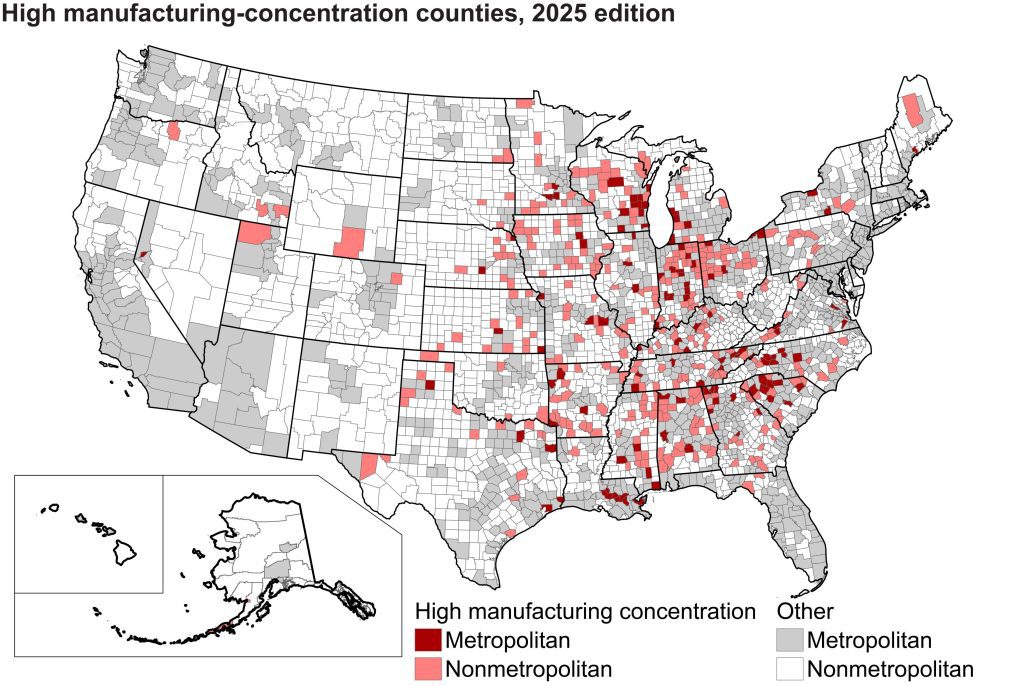
Manufacturing has long been the backbone of many rural communities, especially in the Midwest and the South. These areas often benefit from a legacy of industrial infrastructure, skilled labor, and access to supply chains developed over decades. Factories that once produced textiles, automobiles, or steel have, in many cases, retooled to support advanced manufacturing—such as aerospace components, food processing, or precision equipment.
However, these communities face both opportunities and threats. On one hand, reshoring trends and automation can lead to new investment and improved productivity. On the other hand, job displacement and skills mismatches can leave workers behind if workforce development doesn’t keep pace. The key to resilience here lies in adaptability and continuous upskilling.
Case study
Holmes County, Ohio – Small‑Scale Manufacturing & Community Entrepreneurship
Holmes County stands out for rapidly transitioning from agriculture toward a robust, diversified economy rooted in local entrepreneurship and community networks. Between 2005 and 2019, average household incomes for 27‑year‑olds in the county rose 24% in real terms—among the highest gains nationwide. Notably, a full one-third of workers commute in, boosting regional activity.
Much of this growth is driven by small firms initiated within tight-knit community networks, particularly among the Amish, many of whom moved from dairy farms into small-scale manufacturing and crafts (e.g., woodworking, furniture, roofing). Businesses often support each other across familial and community lines, with shared tools, referrals, and even financing. For example, Treecraft—a furniture maker launched from a home workshop—has grown through community collaboration and local support.
Why it matters: Holmes County shows how strong social capital and local collaboration can nourish entrepreneurial ecosystems even without high-tech infrastructure—turning cultural cohesion into economic diversification and upward mobility.

Mining and Energy Economies
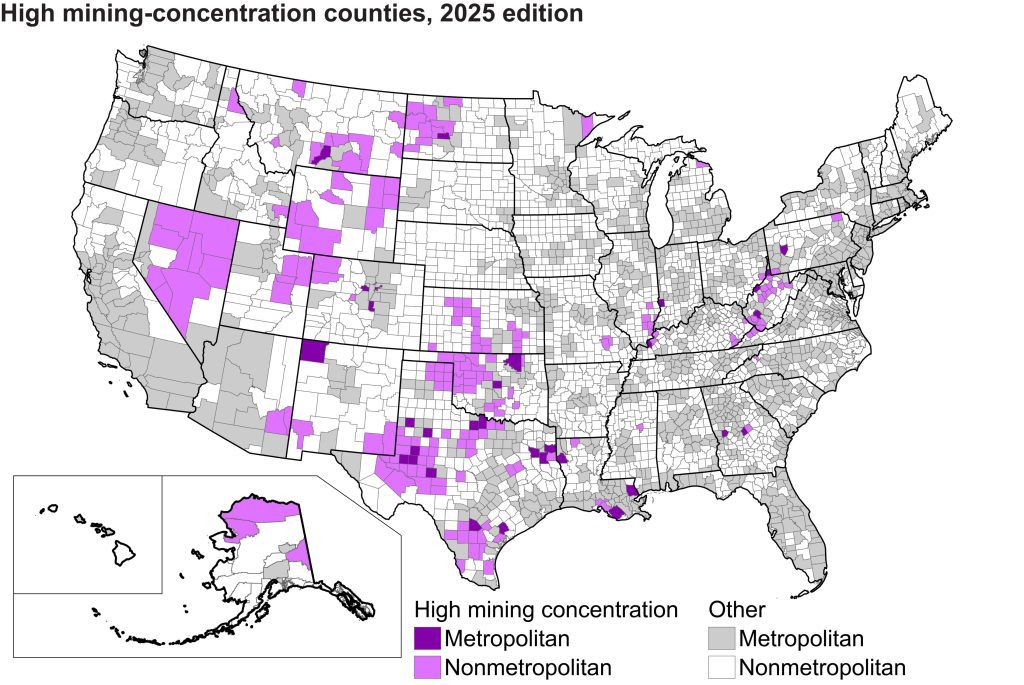
From the Appalachian coal fields to oil-rich basins in Texas, Wyoming, and North Dakota, rural economies built around natural resource extraction have seen significant growth—and volatility. Booms in energy prices can rapidly inject wealth and employment into a region. Local governments benefit from increased tax revenue, which can be used for schools, infrastructure, and community services.
Yet these economies are often highly cyclical and environmentally risky. A drop in global commodity prices or new environmental regulations can quickly reverse fortunes. Moreover, communities reliant on a single resource face long-term sustainability challenges, especially as the world transitions toward clean energy. For these areas, resilience may require investment in diversification strategies that leverage the existing workforce while expanding into new sectors like renewable energy, tourism, or logistics.
Case Study
Mesabi Iron Range, Minnesota – Mining Heritage & Emerging New Economies
For over a century, the Mesabi Range has been shaped by iron mining. While mining remains active, the region is deliberately pursuing economic diversification:
- Former mine lands are being reclaimed and redeveloped into public parks, trails, schools, and housing.
- Investments in renewable energy, healthcare, tourism, and education are forming new pillars of the local economy.
- Visitor attractions—such as the Minnesota Discovery Center and the Hull‑Rust Mine sill—draw interest in industrial heritage and natural landscapes.
Why it matters: This region tracks the transition from a resource‑extractive model toward a mixed economy, using environmental reclamation and cultural heritage to attract visitors and new residents.

Recreation and Tourism-Based Counties
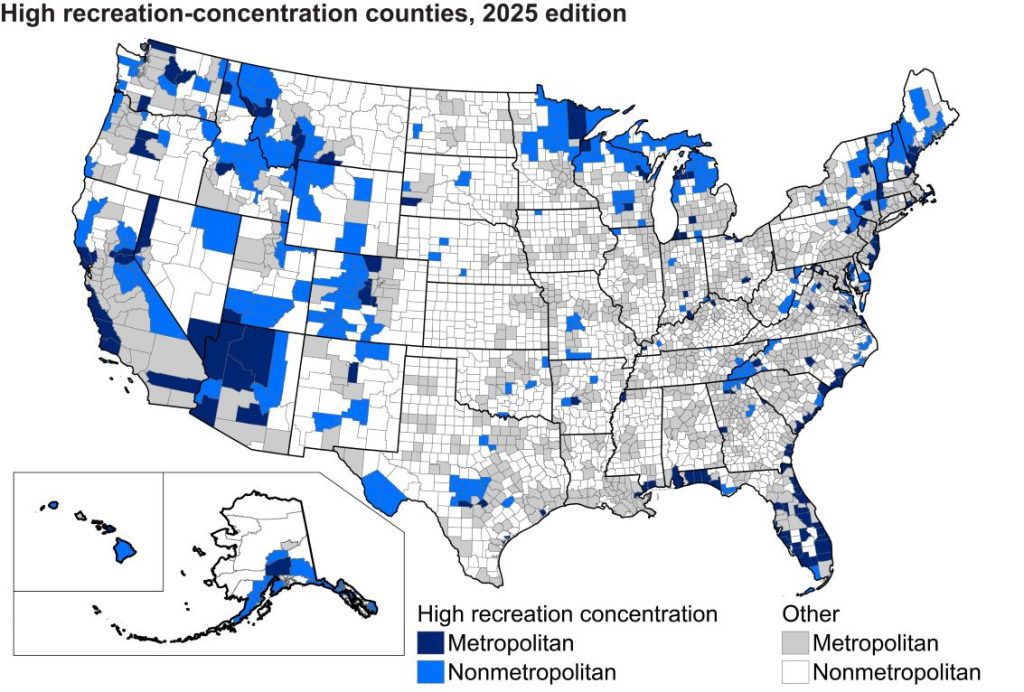
As we’ve explored earlier this year, counties with significant natural beauty, recreational assets, or cultural appeal—such as those in the Mountain West, Great Lakes, and parts of New England—are increasingly leveraging these assets to support local economies. Small towns near national parks, lakes, or ski resorts have become destinations for seasonal tourism, second-home owners, and remote workers seeking quality of life.
This form of economic activity supports a wide range of small businesses—from restaurants and guides to arts venues and boutique lodges. Importantly, these places often see in-migration of creative talent and retirees, contributing to both cultural vibrancy and economic diversification.
Yet tourism-based economies must contend with seasonal volatility, housing affordability pressures, and infrastructure demands. Long-term planning must balance growth with preserving the very assets that attract people in the first place.
Case Study
Galax, Virginia – From Furniture Town to Learning & Tourism Hub
Once dominated by furniture manufacturing—especially by Vaughan‑Bassett in the early 2000s—Galax faced major disruption when global imports devastated the local industry. Yet the community pivoted strategically:
- The Vaughan‑Bassett expansion in 2012 revived local industry, and the Crossroads Rural Entrepreneurial Institute opened in 2005 to foster new startups.
- Simultaneously, downtown revitalization and the arts—anchored by the city’s traditional music culture, the Old Fiddlers Convention, and its proximity to the Blue Ridge Parkway—transformed Galax into a destination for heritage tourism.
Why it matters: Galax demonstrates how a town can weave together legacy industrial skills, creative placemaking, and entrepreneurial capacity-building to diversify beyond a single dominant sector.

Government and Service-Based Counties
In many rural regions—particularly those with lower population density or limited private sector presence—public institutions like schools, hospitals, and local governments serve as anchor employers. These entities offer stable, recession-resistant employment, often with good benefits and community presence.
In some counties, a single school district or rural hospital may be the largest employer, offering not just jobs but essential services like healthcare, child care, and public safety. These places benefit from public investment and policy stability, but often struggle with underfunding and difficulty attracting professionals like teachers and doctors.
Public service economies are particularly important in areas that lack the resources or infrastructure for large-scale private investment. As such, they should be seen not as static or secondary, but as critical pillars of resilience and wellbeing.

Case Study
Highland County, Virginia – Public Services as Economic Anchor
Where public employment leads rural economic resilience
Highland County, located in the Appalachian highlands of western Virginia, illustrates how government and service sectors can serve as vital pillars of rural economic stability—particularly in regions with limited private-sector activity.
- As of 2012, over 34% of all jobs in Highland County were tied to government employment, with 25.7% specifically in local government roles such as education, municipal services, and county administration.
- Public institutions like schools, libraries, and the sheriff’s office are not only major employers but also critical service providers—offering infrastructure, health support, and educational access in this sparsely populated area.
- Though the county is rich in natural resources like timber and farmland, it has struggled with declining population and limited economic diversification, classifying it as a “transitional” economy under the Appalachian Regional Commission framework.
Why it matters: In places like Highland County, the public sector plays a stabilizing role. Even in the absence of large private employers or rapid economic growth, government services sustain local livelihoods and preserve essential community functions. This highlights the importance of continued investment in public institutions as anchors of rural resilience.

The Strength of Diversity
This mosaic of economic types—each with unique assets and vulnerabilities—creates a built-in buffer against economic shocks. When one sector falters, another may provide support. For instance, a downturn in energy prices may hit extraction-heavy counties hard, but regions with tourism or manufacturing might continue to grow. This inter-sectoral diversity is one of rural America’s greatest but often overlooked strengths.
In short, resilient rural economies are diversified rural economies. They draw strength from their differences, from their local identity, and from their ability to evolve.hen one industry declines, another may offer a buffer—making diversification a key pillar of economic resilience.

The Rise of Rural Entrepreneurship: Building Economies from the Ground Up
In the face of shifting global markets, rural America is increasingly finding resilience not through big industry recruitment, but through homegrown entrepreneurship. While legacy sectors like agriculture, manufacturing, and energy still anchor many regions, the real momentum behind new job creation in rural areas is coming from small, locally-driven enterprises. In fact, over half of all new jobs in the most remote U.S. counties now stem from non-farm small businesses—a significant shift that redefines what rural economic development looks like in the 21st century.
Small Businesses, Big Impact
These new ventures take many forms:
- Tech startups operated by remote workers or returning residents.
- Home-based services like repair shops, bookkeeping, and digital design.
- Artisan food producers using local ingredients to access niche markets.
- Tourism and recreation ventures such as guided tours, boutique lodging, or cultural festivals.
Often these businesses start small—sometimes from a kitchen table or backyard barn—but their cumulative impact is transformative. They not only provide direct employment but also stimulate demand for local suppliers, generate tax revenue, and help revitalize main streets.
Tailoring the Ecosystem to Fit the Place
Entrepreneurial ecosystems thrive best when they’re rooted in local realities, not imposed from above. In rural settings, this often means smaller scale, deeper trust networks, and a higher need for flexible support systems.
One of the most effective strategies here is asset-based community development (ABCD). Rather than chasing outside firms, ABCD focuses on leveraging what a community already has:
- Natural capital (landscapes, resources, climate)
- Cultural capital (traditions, heritage, craftsmanship)
- Human capital (skills, relationships, creativity)
Communities that lean into their unique identity—whether it’s a legacy of craftsmanship, an outdoor lifestyle, or Indigenous heritage—are not only more resilient, they’re also more attractive to returning residents, retirees, and lifestyle migrants seeking authenticity, affordability, and connection.
From Grit to Growth: Overcoming Barriers
Despite their promise, rural entrepreneurs often face steep challenges:
- Limited access to capital, especially due to bank consolidation and risk aversion.
- Infrastructure gaps, such as unreliable broadband or workspace–too many empty buildings are left to rot.
- Lack of professional networks, mentoring, and technical assistance.
- Regulatory burdens that may not scale well to very small firms.
This is where targeted local programs and federal support play a crucial role. Initiatives like, Small Business Development Centers (SBDCs), the Rural Microentrepreneur Assistance Program, or USDA’s Value-Added Producer Grants can help reduce the risks associated with launching and sustaining small businesses.
A Cultural Shift in Rural Development
Importantly, promoting entrepreneurship instead of industrial recruitment isn’t just an economic strategy—it’s a cultural one. It reflects a mindset shift from “We need someone to come save our town” to “We already have what we need to build our future.”
This philosophy is evident in efforts like:
- Maker spaces and rural incubators that support microenterprises.
- Peer-to-peer lending circles and community crowdfunding platforms.
- Youth entrepreneurship programs in schools and 4-H clubs.
Rural entrepreneurship isn’t about becoming the next Silicon Valley—it’s about creating locally-rooted, value-driven economies that reflect community values, empower individuals, and keep wealth circulating within the region.
Case Studies
Sarah Calhoun & Red Ants Pants – White Sulphur Springs, Montana
Sector: Lifestyle brand rooted in outdoor culture
- Founded by Sarah Calhoun in 2006 in rural White Sulphur Springs, Montana, Red Ants Pants is a clothing brand created for women in blue‑collar, outdoor professions.
- The brand expanded into a nonprofit foundation and even hosts an annual outdoor music festival that draws visitors and celebrates local labor culture and roots music.
- This venture highlights how leveraging local human and cultural capital can become a distinctive, scalable rural business.
Montana’s Entrepreneurial Ecosystems – Bozeman, Missoula, and Beyond
Sector: Rural tech, remote work, and innovation-enabled startups
- A landmark study by the Montana High Tech Business Alliance and partners found Bozeman and Missoula, along with smaller rural towns, to be thriving centers for high-growth entrepreneurship.
- Entrepreneurs in these areas benefit from dense regional networks of universities, incubators, nonprofits, and public agencies—including Accelerate Montana’s Rural Innovation Initiative targeting rural and Indigenous businesses.
- The study concludes: “entrepreneurs can build global businesses in very small towns,” supported by local mentors, workshops, coworking spaces, and collaborative infrastructure.
Fairfield, Iowa – The Town That Became an Entrepreneurial Hub
Sector: Diverse small businesses in manufacturing, software, and creative industries
- Fairfield is frequently cited as one of America’s most entrepreneurial small towns—by the early 2000s, over 200 businesses had been founded locally, bringing in $250 million in investment and creating thousands of jobs.
- The Fairfield Entrepreneurs Association (FEA) created a supportive local culture—hosting national rural entrepreneurship conferences, mentoring peers, and publishing The Fairfield Edge magazine.
- This model demonstrates how community-driven support and culture-building can transform economic trajectories.

Planning with Typology in Mind: Tailoring Strategy to Economic Reality
Recognizing a region’s dominant economic typology isn’t just a theoretical exercise—it’s a foundational tool for effective rural planning and development. In rural America, no two communities are exactly alike. While some may be shaped by legacy manufacturing, others are rooted in energy extraction, tourism, or public service. This diversity demands equally diverse policy responses, grounded in local realities rather than one-size-fits-all solutions.
Typology-based planning allows local leaders, economic developers, and policymakers to align strategies with strengths, and more importantly, mitigate vulnerabilities. It supports smarter investment, sharper focus, and stronger partnerships. The USDA’s county typologies—covering industries like manufacturing, mining, farming, recreation, and government services—provide a roadmap for understanding these localized economies.
Matching Investment to Industry
Consider the implications of typology-aware planning:
- Manufacturing-intensive counties might prioritize:
- Workforce retraining for automation and robotics.
- Logistics infrastructure, such as rail hubs or intermodal centers.
- Site-readiness for supply chain investment, and adaptive reuse of industrial sites.
- Recreation- and tourism-based economies may focus on:
- Expanding broadband for remote workers and digital nomads.
- Enhancing trail networks, parks, and outdoor access points.
- Supporting small businesses in hospitality, arts, and food.
- Mining and resource-based regions often benefit from:
- Environmental remediation and land reclamation.
- Retraining for skilled trades and renewable energy transitions.
- Economic diversification incentives to avoid boom-and-bust cycles.
- Government-anchored communities may invest in:
- Public sector workforce pipelines (teachers, nurses, first responders).
- Civic infrastructure like libraries, clinics, and broadband.
- Regional service hubs that expand access to public goods in low-density areas.
Tailoring development strategies to typology ensures that communities are not just reacting to change, but positioning themselves for long-term sustainability.
Policy Implications and Tools
Typology-based planning has several practical implications:
- Targeted grantmaking: Federal and state programs (like EDA or USDA Rural Development) can structure calls for proposals that reflect regional strengths, increasing project success and reducing waste.
- Cross-sector collaboration: Knowing a county’s typology can guide partnerships—e.g., aligning a community college’s curriculum with industry clusters or using extension offices to support agritourism ventures.
- Crisis response and recovery: During economic shocks (like COVID-19 or commodity crashes), typology-informed plans help deploy aid quickly and equitably by recognizing where economic exposure is highest.

From Strategy to Stewardship
Ultimately, embracing economic typology is about stewardship—caring for the people, places, and assets that define rural life. It encourages communities to take stock of who they are, what they have, and where they want to go. When local leaders match vision with evidence-based insight, they can craft a development path that is not only resilient, but also authentic, inclusive, and future-oriented.
Real-World Applications: Typology-Based Planning in Action
While economic typology provides a valuable framework for strategic planning, its real power lies in how it’s applied on the ground. Across North America, rural communities and policymakers are using typology-informed strategies to guide investment, shape workforce development, and support long-term resilience. The following two examples illustrate how recognizing a region’s dominant economic characteristics can lead to more targeted, effective, and community-driven economic development.
Case 1: Western North Carolina’s Small Towns Initiative (NC STEP)
Regions: Canton, Old Fort, Robbinsville, Marshall (among others)
Typology Focus: Recreation-driven and distressed small towns
- These communities participated in the North Carolina Small Towns Economic Prosperity (NC STEP) program—a capacity-building initiative supported by the NC Rural Center and regional economic development entity Advantage West. They were selected largely due to their tourism assets and persistent economic distress.
- Old Fort and Canton, for instance, joined regional clusters to develop long-term plans that leveraged heritage tourism, arts and crafts, and destination housing.
- Robbinsville, once a blues coaster economy reliant on biker tourism along the Tail of the Dragon, faced industrial decline. Locals partnered with state coaches to create a downtown revitalization strategy focused on eco-tourism, second-home development, and infrastructure upgrades to mail out diverse economic investment.
- In Marshall, residents worked with NC State University faculty and students to co-create vision designs through community charrettes, focusing on entrepreneurship, promotions, and master planning. These efforts launched new businesses and strengthened civic capacity.
Why This Matters: NC STEP demonstrates how aligning local typology—tourism potential and local craft clusters—with well-designed capacity-building delivers tailored development outcomes. It underscores the importance of pairing asset-based strategy with typology-driven planning.
Case 2: USDA‑ERS County Typology Codes in Action
Nationwide Programmatic Tool
Typology Focus: Industry dependence—manufacturing, mining, recreation, government
- The USDA’s County Typology Codes (2025 edition) classify around 3,144 U.S. counties, indicating which single industry (e.g. manufacturing, mining, government, recreation) dominates local earnings and jobs—and flags multi-industry high concentration counties.
- This data is used by federal and state agencies—including USDA, EDA, Cooperative Extension, and land-grant universities—to prioritize funding, tailor technical assistance, and structure workforce development programs.
- For instance, counties flagged as manufacturing-dependent may receive investment in logistics training and site development, while recreation-dependent counties may qualify for broadband grants and hospitality entrepreneurship support.
- By providing industry-specific insight at the county level, typology codes empower rural communities to design cohesive plans that align with local asset strengths and industry dynamics.
What This Means for Your Planning Approach
| Example | Typology Used | Planning Strategy |
|---|---|---|
| NC STEP towns (NC) | Recreation + distress types | Community-led visioning aligned with tourism and craft heritage |
| USDA‑ERS typology tool | Industry dependence counties | Targeted grants, infrastructure support, and workforce programs tailored by dominant sector |

Looking Ahead: Toward a More Resilient Rural Future
As rural America continues to evolve in the face of technological disruption, demographic shifts, and global economic pressures, so too must the way we understand and talk about these communities. The old narratives—centered solely on decline, agriculture, or outmigration—no longer capture the full complexity or potential of today’s small towns and rural regions.
Yes, agriculture still matters—it remains a vital part of the rural identity and economy. But the real strength of rural places lies in their adaptability, diversity, and people. From family-owned manufacturers in Ohio to tech startups in Montana, and from tourism-based towns in North Carolina to public service hubs in Appalachia, rural economies are writing new stories of innovation and resilience.
This is not a one-size-fits-all future. Instead, it’s a mosaic of local strategies, shaped by unique assets, histories, and values. It’s about recognizing that small towns are not static or stuck in time—they are dynamic, forward-looking, and capable of transformation when given the tools, trust, and targeted support they need.
What Comes Next
Over the next few weeks, this article series will delve deeper into the pillars of rural economic resilience, unpacking how communities across North America are:
- Retaining and expanding existing businesses, with smart strategies like economic gardening and succession planning.
- Fostering entrepreneurial ecosystems, from artisan foods to creative tech, often rooted in cultural identity and local pride.
- Driving innovation through community-based development, place-based investment, and digital infrastructure.
- Learning from international examples, including Canada’s multifaceted approach to rural diversification and immigration.
Together, these stories will offer a compelling and hopeful vision of what rural development can be when it’s asset-driven, inclusive, and tailored to place.
An Invitation
For rural leaders, planners, and engaged citizens, the message is clear: your community’s future is not predetermined—it can be designed. By aligning local knowledge with strategic tools and shared values, small towns can lead the way in building resilient, equitable, and vibrant economies.
So as we look ahead, let’s trade nostalgia for nuance. Let’s honor tradition while embracing transformation. And most of all, let’s recognize the incredible potential that exists in the places so often overlooked—because the future of rural America is already taking shape, one community at a time.

Read More: Understanding and Supporting Diverse Rural Economies
Curious to explore more about rural economic diversity, entrepreneurship, and place-based planning? These curated resources offer case studies, frameworks, and practical tools for rural leaders, planners, and changemakers working to build more resilient local economies.
Recommended Reads
- Strong Towns: A Bottom-Up Revolution for Rebuilding American Prosperity – Charles Marohn
Challenges top-down planning assumptions with a strong case for local entrepreneurship and incremental growth. Our featured book in July. - The New Localism – Bruce Katz & Jeremy Nowak
Shows how power is shifting to cities and regions—rural planners can adapt this model for county and small-town collaborations. - Small Town Solutions : An Economic Development Guide for Small Communities with BIG Dreams (New June 2025) – David Thornell
A collection of tips from a small town Chamber Exec and Economic Developer; note, I just started reading this. - The Creative Community Builder’s Handbook – Tom Borrup
Provides practical tools for linking arts, culture, and entrepreneurship in rural communities. - Revitalizing Rural Economies: A Guide for Practitioners – Chan, Dixon, & Dukelow
Focusing on Canadian rural communities facing economic shifts, this book offers practical strategies for revitalization - From Possibilities to Reality: Save Your Small Town – Deb Brown
At the end of the day it’s about what we do to implement the plan that gets things done; Our review from November 2024. - Rural Renaissance: Revitalizing America’s Hometowns through Clean Power – L. Michelle Moore
Tools to bring the benefits of renewable energy to small communities, particularly in rural America
Federal Policy & Planning Resources
- USDA Rural Development – Business Programs
Loans, grants, and technical assistance for rural entrepreneurs and business development.
rd.usda.gov - EDA Economic Development Tools – U.S. Dept. of Commerce
Resource guides and planning tools tailored to regional typologies and cluster strategies.
eda.gov - Rural Microentrepreneur Assistance Program (RMAP)
Loan and technical support for very small businesses in rural areas.
fsa.usda.gov/programs-and-services/farm-loan-programs - ARC County Economic Status Classifications
Framework for identifying economically distressed areas and targeting investment accordingly.
arc.gov
Online Tools & Networks
- USDA County Typology Codes Tool
Identify your region’s dominant industries for better-targeted planning and funding.
ers.usda.gov - National Association of Development Organizations (NADO)
Peer networks and technical resources for regional planning and rural economic development.
nado.org - Rural Innovation Network – Center on Rural Innovation
Offers best practices, funding maps, and broadband/equity planning tools.
ruralinnovation.us - Business Retention & Expansion Toolkit – University of Minnesota Extension
A hands-on framework for building effective BRE programs tailored to small-town contexts.
extension.umn.edu - The RII Community Toolkit – Center on Rural Innovation (CORI)
Four tools geared toward communities developing new or additional efforts as part of their approach to support digital and innovation-based jobs.
ruralinnovation.us - The Main Street Approach – National Main Street Center
A proven framework for revitalizing commercial districts through asset-based development and inclusive economic strategies.
mainstreet.org
Keep exploring. Keep adapting.
Our August theme is Economic Resilience in Small Town & Rural America. Economic resilience starts by recognizing what makes your rural region unique—and supporting it with smart tools, inclusive planning, and bottom-up leadership.
Looking for more insights? These resources offer a starting point for anyone working to strengthen policy that works for rural communities—whether you’re a planner, council member, or community leader.
The Best Books for Rural Development and Planning in 2025
(As an Amazon Associate, we may earn commissions from qualifying purchases. Check your local library or bookshop, too.)