
Signal and Story: Communications Infrastructure in Rural America
Somewhere between the power plant and the water tower, most communities hide a third piece of critical infrastructure: the signal that carries their stories. It’s easy to spot the pipes and the poles—harder to see the newspaper office on Main Street, the AM tower out by the highway, or the fiber buried under the county road. Yet that invisible web of communications is what lets local residents find out when the bridge is closing, how the school levy fared, or whether the storm will arrive before the big game is over.
Our June series on communications, utilities, and energy (CUE) starts with a simple idea: in rural America, signal and story belong in the same conversation, and they both belong in the local comprehensive plan. Today, we’re going to cover print and broadcast media in our comprehensive plans, broadband technology and access, cellular technology and tower regulation, and in general communications as community infrastructure.

Print and Broadcast Media
Local newspapers and AM radio are still the backbone of rural civic life, even as the rest of the media world melts into the feed. In an age when most people encounter news as a trickle of posts and push alerts, those analog institutions remain the outlets who reliably show up at the city council meetings and the school board workshops.
The newspaper as public infrastructure
The health of local media is a genuine infrastructure issue—one with measurable consequences for governance, civic engagement, and community cohesion. If you want to see how “signal” and “story” come together in rural America, start on Main Street, not on your phone.
In Thayer County, Nebraska, the Hebron Journal-Register traces its lineage back to Erasmus Correll’s 1871 Hebron Journal, one of a succession of county papers that have chronicled local life since the county itself was established. Over the decades the Journal‑Register and its predecessors have merged, folded, and resurrected, but the basic function remains the same: a weekly digest of births and deaths, road projects and rezonings, box scores and bond issues.
In the comprehensive plans I’ve worked on, “communications” sits side by side with water and power infrastructure, and the first bullet under that heading isn’t Facebook; it’s newspapers. Kimball, Nebraska’s plan relates the story of the Western Nebraska Observer, which has been on the job since 1885, and now like so many others publishes both in print and online.
In Clay County, Nebraska’s plan, for instance, we devote a page to the Clay County News and its 19th‑century predecessors, noting that the current weekly is the survivor of some twenty titles printed since 1875. When a tornado knocked down the parapet of the Clay County News building in 2023, they still made press; the paper covered its own disaster in the next issue, and we recorded that fact in the comprehensive plan as part of the county’s resilience story.
Our new news deserts
The United States has lost nearly 3,500 newspapers and more than 270,000 newspaper jobs over the past two decades, leaving 50 million people in “news deserts”—areas where people have limited or no access to reliable local news sources. Northwestern University’s Medill School of Journalism tracked 136 newspaper closures in 2025 alone, up from 130 the year before. The local journalism workforce has thinned even more dramatically than the outlet count suggests. More than two-thirds of U.S. counties have fewer than 10 local journalists per 100,000 residents. The national average shows a 75% decline from 2002. The consequences reach beyond journalism. Research shows that the loss of local newspapers is associated with significant increases in property and victimless crimes, declines in voter turnout, and heightened political polarization. This is not a soft cultural concern. It is a governance problem with hard, measurable effects on rural communities.
The geography of closure matters. 90% of new digital journalism startups are in cities. Rural and less wealthy communities—the very places where news deserts are most endemic—continue to fall further behind. The August 2025 shutdown of News Media Corporation, which closed 23 news operations across five states in a single announcement, was a vivid illustration of how quickly corporate financial trouble can strip entire regions of their local coverage
Broadcast radio and the farmer‑owned newsroom
If newspapers are the ledger of record, local AM radio is the running commentary. Most rural counties still sit inside overlapping radio markets where small AM stations mix farm reports, swap shops, funeral notices, and high‑school sports with classic country or talk radio. Our small town and rural county comprehensive plans read like catalogues of call signs: KIMB in Kimball, a cluster of AM and FM frequencies in Grand Island, and a heavy sprinkling of signals out of Hastings and Kearney that spill across county lines. I happen to live at the edge of several radio signals and punch the buttons in the car depending which direction I’m heading.
Public radio stations affiliated with NPR have also expanded their rural footprints in recent years, and many agricultural broadcasters have added podcasting and digital streams. (Disclosure: I am a member of Nebraska Public Media and a long-time supporter of KRFC-FM back in Ft. Collins.) Behind some of the radio stations near me sits a unique institution: the Nebraska Rural Radio Association, a farmer‑ and rancher‑owned cooperative that has been broadcasting since 1948. Through its Rural Radio Network—a constellation of roughly fourteen AM and FM stations stretching across greater Nebraska—the association pushes out grain and livestock markets, weather alerts, and ag‑policy news that tie together listeners from the Sandhills to the Platte.
The core of the rural radio ecosystem remains a broadcast tower, a transmitter, and a relatively modest operating budget. FCC licensing and ownership rules for rural radio have been largely stable, though ongoing consolidation among ownership groups warrants attention from planners who care about local content. Over the air or streaming a feed, radio may be the last best source of local news in many small towns and rural communities.
Fractured feeds and the problem of audience
The irony is that as local newspapers and radio stations fight to stay solvent, the overall supply of “news” in people’s lives has never been higher. Recent work on news habits shared by The Pew Charitable Trusts describes an environment where information pours in from every direction—social feeds, text threads, podcasts, push alerts—but fewer people feel they’re following the news “all or most of the time.” Among younger adults especially, political and civic news shows up incidentally in social media scrolls rather than by intentional choice, and many say they trust what they see on platforms as much as, or more than, what they get from traditional outlets.
For rural planners and local officials, that creates a wickedly practical problem: how do you reach people who are drowning in information but starved for shared facts? Our comprehensive plans in places like Kimball and Burwell, Hall County or Clay County all commit to “continue to support local news—in print, on air, and online”—an acknowledgment that if you lose the newspaper and the radio station, you don’t just lose nostalgia; you lose the last broadly shared channels for public notice and debate.
The nonprofit sector has stepped into the communications gap—but unevenly. Newsrooms like Mississippi Today and Deep South Today are producing solutions-focused reporting on issues critical to the communities they serve, and similar outlets have emerged in states from Maine to Montana. The Institute for Nonprofit News (INN) now counts over 400 member organizations. Philanthropic funding from grantors like the Knight Foundation and MacArthur Foundation has been essential. The challenge is sustainability. Grant cycles don’t match the long-term economics of community journalism, and most nonprofit newsrooms are thinly staffed. For rural communities, the most important development may be the emergence of locally-owned cooperative and community news models—outlets governed by their readers and rooted in their coverage area in ways that national ownership never can be.
The US is not alone in putting this in the plan; the UK’s Amplify: Local Media Action Plan, for example, treats local news as core democratic infrastructure and backs that up with funding and regulatory support. Yet our same communities know that any single channel is no longer enough; a public hearing notice that once ran in the legal section now has to be echoed in Facebook groups, text alerts, and school newsletters to have a chance of being seen.
In that sense, the communications infrastructure chapter in a comprehensive plan is not just about towers and spectrum; it’s about stitching together a fragmented public sphere. Newspapers and AM radio give rural towns something like a common front porch; social media, for all its reach, tends to pull people back inside their own houses, each glowing screen tuned to a different reality. When planners talk about “supporting local news” today, they’re really talking about building and maintaining the shared signal—and the shared story—that makes a community possible in the first place.
A community’s communications plan should account for local media as part of its public information infrastructure—not just broadband pipes and cell towers. Who tells your community about a water main break, a zoning hearing, or a public health emergency? If the answer is “nobody,” that’s a planning problem waiting to happen.

Rural and Small Town Social Media
We may not go into details inside the typical comprehensive plan about local social media, but it can be a valuable tool for learning as well as communications and community engagement.
Narrative podcasts about small towns
These podcasts lean into storytelling about particular towns, people, and projects.
- Reimagine Rural: Produced by Tony Pipa at the Brookings Institution, this show visits rural towns in the United States that are experiencing positive change and looks at how public investment and policy are shaping those stories. It’s very useful if you like case‑study style narratives and want to hear local voices along with policy context.
- The Growing Small Towns Show / Podcast: Hosted by Rebecca Undem, this series blends interviews with rural entrepreneurs, civic leaders, and “small‑town champions,” focusing on what’s working in small towns and how to build people‑centered, future‑minded communities. Episodes often talk about leadership culture, community engagement, and small‑scale economic development in ways that feel very grounded.
- The Yonder Report: A short, fast‑paced rural news roundup from the Center for Rural Strategies that highlights local efforts, rural economic development, agriculture, and health issues in rural communities. It’s more newsy than deep‑dive, but good for staying aware of what’s happening across rural America.
- Strong Towns Podcast: While not limited to small towns or rural areas, Strong Towns is particularly suited to small towns, people, and projects. Plus Chuck and the gang are just really cool people. Even when I don’t always agree with what they have to say it still makes me think.
- Sheila Jenkinson’s Growing Small Town Nebraska podcast covers our local with a national perspective, as well as national from a local perspective.
Policy and practice podcasts on rural development
These podcasts are more explicitly about rural community and economic development, often featuring practitioners, funders, and policy experts.
- Rural Strong: Hosted by veteran economic developer Joe Barker, this podcast explores the “people, partnerships, and projects” driving economic growth in rural America, using interview‑style episodes with practitioners such as regional development leaders, local economic developers, and small‑town revitalization experts to discuss real challenges, bold solutions, and practical strategies for building resilient rural economies. I was Joe’s guest on a session earlier this year.
- The Rural Impact Podcast: Michelle Rathman looks at how policy decisions play out on the ground in rural places, covering economic development, healthcare, education, and resilience.
- Rural Matters: Focuses on education, health, economic development, and other key issues in rural communities, bringing together experts and practitioners to talk about strategies and solutions.
- Pathways to Rural Prosperity: While no longer being updated, Don Macke (e2 Entrepreneurial Ecosystems) interviewed rural development leaders, entrepreneurs, and practitioners about building entrepreneurial ecosystems in small communities.
- Funding Rural: Three back seasons are available where Erin Borla (Roundhouse Foundation) explores philanthropy, creative placemaking, and economic development in rural and Indigenous communities, with an emphasis on how projects actually get funded and sustained.
Rural news and blogs
There are a few sites for rural news out there. Blogs tend to come and go (ours being an example). The written word continues to provide insights into rural and small town challenges and successes.
- The Daily Yonder is is an online news and storytelling platform dedicated to rural America, launched in 2007 by the nonprofit Center for Rural Strategies to provide original reporting, commentary, and analysis about and for rural people and places, bridge rural–urban divides, and fill gaps left by declining local coverage by publishing one to several stories a day on topics like agriculture, economics, politics, and community life—often written by rural contributors themselves and shared freely with local outlets—while operating as an independent, nonpartisan national news organization that now reaches hundreds of thousands of readers and listeners each year through its website, audio newscasts, and content partnerships..
- Rural Resurrection blog: Chris Solberg writes about saving small-town America – specifically, small towns in the Midwest. These quaint towns have dotted the countryside that truly defines the term “small-town feeling” that is so horribly misused today. These great communities are hurting, not only from “brain drain”, but the changing economy of the post-industrial era. Slowly, gracefully, many of these communities are fading away, remaining only in the hearts of those who once lived there.
- Center for Rural Affairs Blog Posts & Stories: The Center for Rural Affairs regularly posts about rural entrepreneurship, small business support, local food systems, and policy issues facing rural communities. Articles emphasize asset‑based development and practical steps rural residents can take to strengthen their local economies.
- Vibrant Rural Communities case study series (NADO Research Foundation): A set of case studies on how rural regions and small towns leverage assets, protect resources, and shape strategic investments to strengthen local and regional economies. It reads like a classic planning‐case compendium and is handy if you like to see specific tools and approaches laid out.
- Recommended by Tony Pipa at Brookings— Resource Rural’s Story Wire: RR partners with local leaders and organizations to help share stores and show how public and private investment is making a real difference.
- Recommended by Sara June Jo-Saebo— Barn Raising Media: Publisher of Barn Raiser online as an independent source for rural and small town news.
What sources do you use for small town and rural news and policy updates?

Broadband Technology and Access
Broadband technology and access is the part of the story where the wires and airwaves finally catch up with the people. When I started out in local economic development, we had to place a long‑distance phone call just to hit the nearest internet point‑of‑presence; “broadband” meant 56k if the wind wasn’t blowing too hard across the copper.
Today, rural broadband is treated as core infrastructure for rural development because it underpins modern agriculture, business, education, health, and governance; the development case is that connecting rural areas boosts productivity, incomes, and resilience in ways similar to roads or electricity. Yet while the infrastructure is bigger, faster, and better funded than anything we imagined back then, we still haven’t closed the gap.
The map and the mile
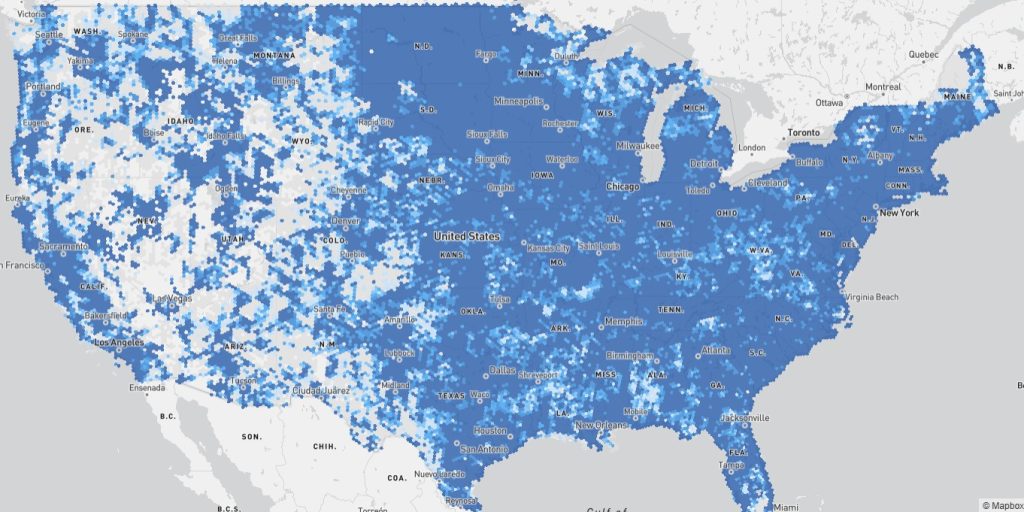
On paper, rural broadband has never looked stronger. The FCC’s National Broadband Map is full of bright colors and big promises: fixed providers reporting 100/20 or even 250/25 Mbps service blanketing town after town. Canada has their own National Broadband Map, too.
In places like Kimball, Burwell, and Clay County, Nebraska, the official story is that “all locations” have at least one high‑speed option available by fixed service. Walk the ground, though, and the map starts to blur. Residents will tell you where the cable stops two farms short of their driveway, where the DSL lines were never upgraded, and where the “up to” speed on the marketing flyer becomes a fraction of that by suppertime.
That’s my house, too. The map says we can get fixed wireless. The local tech for the national service provider laughed when he rolled into the farm yard and apologized for their central dispatch. No clear line of site in any direction and we barely get a cell signal. Who thought trees and hills would be such a problem on the Nebraska prairie?
This is a tension local plans have to live with: federal datasets want to see polygons and percentages; citizens care about the last gravel mile to their house. When you write “Support improvements in high‑speed wired and wireless communications” into a plan, you’re really talking about both worlds—the map the grant writer has to submit and the dead zone where the volunteer firefighter can’t get a text alert.
The federal firehose
The second tension is temporal. Rural broadband has been a “priority” in every administration’s talking points for the last thirty years. What’s different now is the scale of the funding. The Federal Broadband Equity, Access, and Deployment (BEAD) Program is the headline: tens of billions for state‑run broadband funds that are finally sized for the problem. Layer on top of that USDA’s ReConnect grants and loans, the old E‑Rate program for schools and libraries, and a scattering of smaller digital equity grants, and you get something like a federal firehose pointed at the rural right‑of‑way.
A few years ago when I worked in Minnesota, we had the Blandin Foundation’s Minnesota Intelligent Rural Communities (MIRC) initiative. MIRC communities weren’t swimming in capital dollars; they were learning how to build broadband vision, leadership, and digital inclusion projects with what they had. That work—broadband champions, cross‑sector task forces, local project lists—turned out to be exactly the kind of “readiness” today’s big federal programs are looking for.
From a comprehensive‑plan perspective, the question isn’t whether the money exists; it’s whether your community is ready when it shows up. Do you have shovel‑ready projects? Rights‑of‑way policies? A sense of where middle‑mile fiber should run and which last‑mile pockets are truly unserved? The plans I’ve been working on increasingly treat broadband the way we’ve always treated water and sewer—one more utility that needs a capital improvements plan, not just a wish list.
Yet some states don’t seem to be all on-board for their local communities. As Pew Charitable Trust recently related, “Some state offices risk sunsetting prematurely, before the deployment of billions in federal funds.” In, Nebraska connected the first household in the U.S. using BEAD funds near Ogallala, utilizing fixed wireless technology. Yet, my home state also left money on the table in the first round. The Nebraska Broadband Office has had to reopen applications to allocate the remaining uncommitted BEAD funds to cover more unserved locations.
Fiber, fixed wireless, satellite
It seems like every rural broadband debate eventually devolves into a technology argument, but the lived reality is more pragmatic. Downtowns and close‑in neighborhoods are natural fiber candidates: short drops, dense customers, poles and conduits already in place. Outside town, fixed wireless often carries the load, especially where tower sites are available and foliage is forgiving. Out beyond even that—out where the gravel turns to two‑track and the section lines get stretchy—satellite has become the de facto backstop. Starlink and its competitors are the new long‑distance call to the POP… and my broadband bill feels like it did back when I was paying Ma Bell for that particular “luxury”.
Comprehensive plans usually sidestep the brand names and focus instead on outcomes: minimum service levels, redundancy, and resilience. The technology mix will change over the life of the plan; the point is to keep updating zoning, permitting, and franchise rules so that whichever technology wins next still has a clear path into town.
Middle‑mile, last‑mile, and the bits in between
One shift in the broadband discussion is the “middle‑mile” versus “last‑mile” infrastructure. Middle‑mile is the long‑haul stuff: the fiber routes along the railroad, the county‑to‑county trunk lines, the rings that tie into data centers and power plants. Last‑mile is the messy part: the drop to the farmstead, the splice in the alley, the wireless hop over the lake.
Our local plans are starting to recognize that you need both in the same way you need both a transmission line and a residential feeder. Hall County’s energy park, Kimball’s discussion of data centers, Aztec, New Mexico’s municipal fiber assets—all of these are middle‑mile anchors disguised as economic development projects. Once you have those anchors, the plan’s job is to carve out corridors, protect easements, and make sure every new subdivision and industrial site is built “broadband‑ready” by default.
Digital inclusion in the real world
If you’ve ever had to explain to a planning commission why “available” broadband isn’t the same as “affordable” or “usable,” you know digital inclusion is more than a communications buzzword. It’s a three‑legged stool:
- Access: Is there actually a pipe (or signal) to the premises?
- Affordability: Can the household pay the monthly bill without skipping groceries?
- Adoption: Do they have devices, skills, and reasons to get online in the first place?
The comprehensive plans I’ve worked on cite American Community Survey (ACS) numbers the way older plans cited building permits: households with no telephone, no internet subscription, or reliance solely on cellular data. Those statistics turn into goals about “options for remote work and community participation,” about “supporting digital literacy,” about “ensuring residents can access telehealth and online education.” In other words, digital inclusion stops being a charity project and becomes one more piece of the infrastructure puzzle.
I saw that up close in Minnesota’s MIRC initiative, where the Blandin Foundation helped small towns pair infrastructure projects with digital literacy classes, device refurbishing, and outreach through schools and libraries. The lesson for today’s local leaders is that a broadband line on the pole is only half the job; you also need trusted local partners who can help neighbors cross the digital threshold.
Local tools: maps, policies, and “Dig Once”
The tools planners have at hand aren’t glamorous, but they matter. Broadband mapping projects—whether state‑led or regional—give you a baseline. Municipal or county‑level digital equity plans can knit together schools, libraries, health providers, and employers under a shared strategy. And then there’s the workhorse: Dig Once.
Dig Once is exactly what it sounds like. Any time you open up a street or a trench in the public right‑of‑way, you drop in conduit—sometimes your own, sometimes in partnership with a carrier. You don’t know exactly who will light that conduit ten years from now, but you know that fiber without a trench is a lot cheaper than fiber with one. Communities as diverse as Aztec and Grand Island are already baking Dig Once into local language, and I expect to see that spread as more decisionmakers realize how expensive it is to retrofit a street that was rebuilt without a thought for broadband.
The long‑distance call, revisited
For those of us who remember dialing out to a distant POP just to get a text‑only web page to load (slowly), today’s broadband conversation can feel both exhilarating and infuriating. We’ve gone from pleading for a single T1 line to arguing about whether 100/20 counts as “served.” Somewhere between those two points is the work that matters: making sure every household in town can get online for school, work, health care, and civic life without having to choose between the internet bill and the heating bill.
That’s what this section is really about. Not the alphabet soup of programs, not the marketing speeds, but the slow, patient process of treating broadband as infrastructure, digital inclusion as a core public value, and the last farm lane at the edge of the county as just as deserving of a decent connection as the storefront on Main Street.

Cellular Technology and Tower Regulation
The world of wireless towers is where our rural vistas meets the fine print of federal law. We all like the idea of cell service but we don’t want the ugly cell towers. The reality of 4G and 5G is they rely on a checkerboard of small sites tucked into rights‑of‑way and perched on rooftops. The technology wants density. Our landscapes and ordinances are still learning how to live with that.
More bars, more poles
The basic physics haven’t changed: higher frequencies don’t travel as far or penetrate as well. What has changed is how frankly the engineers say it in the public hearing. Industry primers and municipal FAQs now stress that “small cell” 4G and 5G equipment will be mounted in a far denser pattern than the old macro towers, often every few hundred feet along a corridor, especially in developed areas. The FCC’s own orders talk about “densification” of wireless networks and treat those small cells as a distinct class of infrastructure for regulatory purposes, with their own timelines and fee caps.
That’s why you see comprehensive plans warning that “new technologies, such as 5G cellular service, generally require a larger number of shorter wireless towers,” whether the jurisdiction is Kimball, Burwell, Thayer County, Hall County, or elsewhere. The local story is the same: where residents used to see one or two towers casting a wide net, they’re now being asked to accept clusters of shorter poles along highways, on Main Street, and even in front of their houses.
The law of the land: FCC rules and shot clocks
If the physics drive density, the law drives speed. Since the Telecommunications Act of 1996, Congress has told local governments they can’t “zone out” wireless service or unreasonably discriminate among providers, and they can’t deny an application based on the environmental or health effects of radiofrequency emissions so long as the site meets FCC limits. The FCC then layered on a series of “shot clocks”—deadlines after which a delayed local decision can be treated as a denial or even “deemed approved.”
The current framework, refined in the 2018 small‑cell orders and carried into the Code of Federal Regulations, gives local governments 60 days to act on collocation of small wireless facilities on existing structures and 90 days for new small‑cell poles. For larger “macro” towers, older 90‑day and 150‑day clocks still apply. If you blow the deadline, you invite litigation; some orders even contemplate automatic approvals if the local government doesn’t act.
This is also the part of the law that frustrates a lot of public hearings. Section 332(c)(7)(B)(iv) of the Telecommunications Act says, in plain English, that if a proposed tower or antenna complies with the FCC’s radiofrequency exposure limits, state and local governments “may not regulate the placement, construction, and modification” of that facility on the basis of the environmental or health effects of those emissions. The FCC is the sole referee on RF health; local boards can ask an applicant to certify compliance with federal standards, but they cannot deny a permit because neighbors are worried about cancer, headaches, or “radiation” in general.
I’m not a fan of state or federal pre-emption of local authority. I’m not a fan of shot clocks leading to rushed decisions. Myself, I would be more inclined to simply deny a shot-clock application for insufficient justification against zoning criteria, but these days I help write the rules, not do the paperwork. That said, the pubic health pre-emptions do seem to be an issue best dealt with at a national level.
All this pressure has filtered down into local ordinances. Grand Island, for example, writes the FCC shot‑clock timelines directly into its zoning code, spelling out how “eligible facilities requests” will be processed within 60 days and warning that applications must be handled consistent with federal law. When we write comprehensive‑plan policies like “periodically review zoning regulations for conformance with broadband technological advances and FCC mandates,” that’s not abstract—it’s about keeping your code in sync with a moving federal target.
Aesthetics, character, and the limits of control
For planners and councils, the natural instinct is to reach for aesthetics: if we can’t say no on public health grounds, maybe we can at least make it look decent. The good news is that courts and regulators still recognize a lane for “reasonable” design standards. Model ordinances developed by groups like Scenic America point out that the 1996 Act preserves local authority over tower height, setbacks, co‑location, and camouflage, so long as regulations don’t amount to an effective prohibition of service or discriminate among similar providers.
In practice, that’s led to a toolkit of stealth designs—poles disguised as trees or church steeples, antennas hidden in cupolas or on silos, color and finish requirements to blend structures into the skyline. There’s one cell site between Cheyenne, Wyoming, and Fort Collins, Colorado, that looked like a large metal bison. Historic‑district guidelines often insist that any telecom equipment be “substantially invisible” and that viewsheds from landmark structures not be impaired, echoing broader preservation principles.
We’re not inventing this from whole cloth. Chester County, Pennsylvania’s cellular facilities guide, Franklin County, Kentucky’s small‑cell ordinance, and a host of municipal codes elsewhere now require stealth designs—camouflaged poles, concealed cabling, co‑location on existing structures—especially in neighborhoods and historic districts. Even many infrastructure providers talk about ‘stealth towers’ as a standard product line, not a boutique exception.
How about a cell array to go with the bats in your belfry?
The bad news is that the line between “reasonable aesthetics” and “effective prohibition” is litigated constantly. Cities from California to the East Coast have found themselves in court for trying to push 5G small cells out of prominent locations, sometimes after residents raise health or property‑value concerns under the banner of “neighborhood character.” Industry lawyers argue that detailed design review, high fees, or broad “visual impact” tests add up to unreasonable barriers; the FCC’s recent rulemakings have openly targeted “state and local limits on deployment…conditioning of approval on aesthetic or similar criteria, and other impediments to building.”
That’s the tightrope all communities walk. In my comprehensive plan process, we talk about “shot clocks,” “stealth towers,” and “visual impact” not because I’m obsessed with Law and Order trivia, but because those words mark the boundaries of local discretion. Within those boundaries, you can write standards that keep towers off the courthouse lawn, protect key views of grain elevators and bluffs, and encourage co‑location instead of new poles. Step outside them, and you risk a federal preemption fight you probably can’t afford.
Tribal connectivity: a distinct and urgent challenge
Tribal communities face a communications infrastructure deficit that goes beyond what any single federal program has yet to solve. Remoteness, complex federal land ownership, historical underinvestment, and jurisdictional complexity all compound the challenge. NTIA paused the second round of its Tribal Broadband Connectivity Program in November 2025 in an effort to reduce administrative burdens, with a new funding notice expected to make at least $500 million available in spring or early summer of 2026. The first round of the program connected 5,800 homes—meaningful progress, but a fraction of the need.
For tribal planners and the non-tribal local governments that neighbor tribal lands, the connectivity gap is also a regional economic development issue. Supply chains, tourism, healthcare, and emergency services all cross jurisdictional lines. Coordinated regional approaches to rural connectivity—including tribal participation in regional broadband planning—are underutilized and worth pursuing.
Public safety and the rural coverage paradox
Meanwhile, out past the regulatory minefield, the lived experience is simple: in many rural counties, cell phones still don’t work where people most need them. If you don’t believe me, take a drive across the scenic routes along the Kansas-Nebraska state line, or along the Niobrara River in the Sandhills. Our same comprehensive plans that anticipate “an increasing number of requests to approve cellular and broadband antennae and towers” also record residents’ complaints that voice and data coverage are “poor to nonexistent outside of town.”
That’s not just an inconvenience; it’s a public safety problem. Volunteer fire departments, sheriff’s deputies, and road crews rely on cellular networks when radios cut out or people call 911 from highways and farm fields. When we label cell coverage as a public‑safety issue in the plan, we’re reminding ourselves that every tower decision carries two risks: overbuild the wrong way and you scar the landscape; underbuild, or delay too long, and somebody’s call for help may not get through.
The big idea in all of this is humility. New technologies really do require more, smaller towers. Federal law really does constrain how we say “yes, but” or “no, not there.” And yet, within those constraints, there’s still room to write local rules that respect the skyline, protect historic main streets, and slowly, stubbornly, fill in the dead zones on the map. That’s the work we’re trying to capture: the uneasy marriage of radio waves, rural character, and the rule of law.

Communications as Community Infrastructure
Communications belongs in the comprehensive plan as a utility category with civic side effects. The implementation toolbox should read less like a museum label for newspapers and towers, and more like a set of public works actions for signal, access, and local storytelling.
For a long time, public plans treated communications as the soft stuff: newspapers over here, cable franchise issues over there, maybe recommending tower permits if somebody complained loudly enough. That no longer works. The plans I’ve worked on group communications with utilities and energy as essential infrastructure; local news, broadband, and wireless networks now function as core systems of civic and economic life, every bit as consequential as roads, water lines, and substations.
Seen that way, communications infrastructure has three layers.
- First, there is the physical layer: fiber routes, conduit, towers, rooftops, utility poles, and equipment shelters.
- Second, there is the service layer: broadband subscriptions, cellular coverage, local radio, newspapers, and digital access points at schools and libraries.
- Third, there is the civic layer: the local institutions that turn connectivity into participation—public notices that people actually see, trusted journalism that still shows up at the meeting, and communication channels that still function when the power flickers or the weather turns.
The old mistake was to separate those layers as though they had nothing to do with each other. In practice, they rise and fall together. A town can have “served” broadband on a map and still lack affordable access. It can approve more towers and still leave the valley road in a dead zone. It can boast fiber on Main Street and still watch civic life weaken if nobody is left to cover the school board or explain the bond issue. That is why the communications section should do more than describe conditions. It should establish a toolbox for implementation.
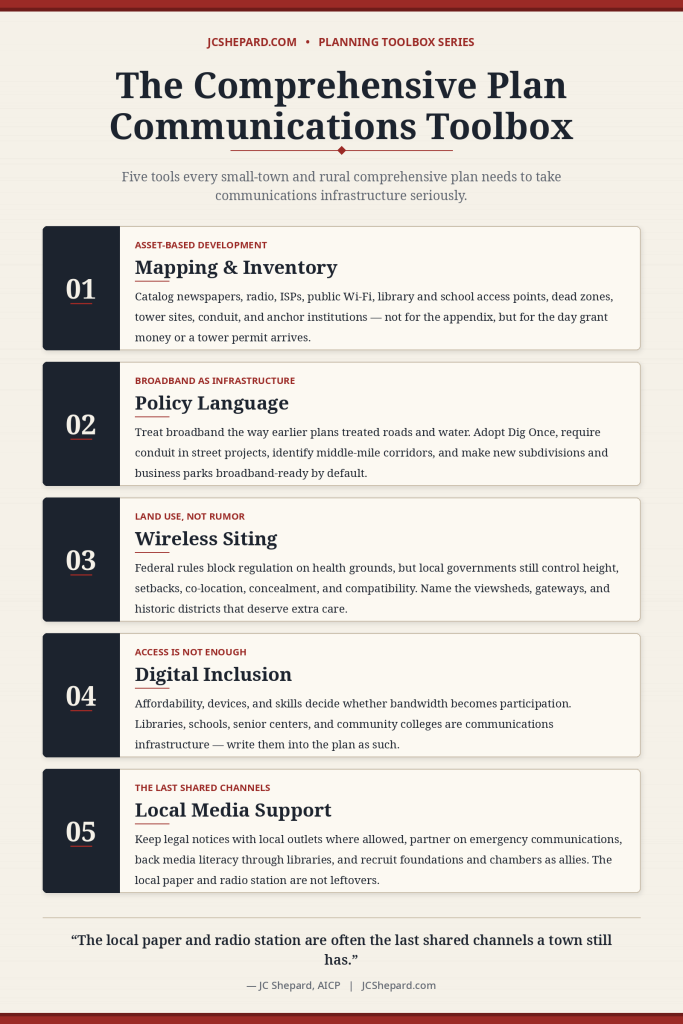
The comprehensive plan communications toolbox
A good communications element should start with mapping and inventory for asset-based development. That means cataloging newspapers, radio service, internet providers, public Wi‑Fi locations, library and school access points, cellular dead zones, tower sites, conduit assets, and anchor institutions with potential broadband backhaul needs. The point is not to produce one more pretty figure for the appendix. The point is to create something local officials can use when grant money appears, when a provider requests a tower permit, or when residents insist the official coverage map does not match reality.
The second tool is policy language that treats broadband the way earlier plans treated roads and water extensions. Many of our plans gesture in this direction with simple, durable action items: support high‑speed wired and wireless improvements; periodically review zoning for conformance with broadband advances and FCC mandates; coordinate with providers as technology changes. That is the right foundation, but it can be sharpened. The plan can direct the community to adopt Dig Once policies, require conduit in major street projects, identify preferred corridors for middle‑mile infrastructure, and make new business parks and subdivisions broadband‑ready by default. My work can always be made better, as can yours.
The third tool is wireless siting policy rooted in land use rather than rumor. The federal rules are what they are; local governments cannot regulate towers on the basis of alleged health effects if the facilities meet FCC standards. But they still retain room to regulate height, setbacks, co‑location, concealment, and compatibility with local character, so long as they do not effectively prohibit service. That means a comprehensive plan can and should identify where wireless facilities belong, where stealth designs are preferred, where co‑location should be mandatory, and which viewsheds, gateways, and historic districts deserve extra care.
The fourth tool is digital inclusion, which deserves to be written into the plan as a practical objective, not a grant buzzword. Access is not enough if the monthly bill is unaffordable, if the household relies on a single cracked phone, or if older residents and small businesses still need help crossing from nominal connectivity to actual use. Libraries, schools, senior centers, and community colleges all become communications infrastructure in this broader sense, because they help translate bandwidth into skills and participation. A plan that ignores that reality will overestimate how “connected” the community really is.
The fifth tool is explicit support for local media. Here the comprehensive plan has to be a little bolder than us planners are used to being. The model language already exists in my plans: continue to support local news in print, on air, and online. That can be expanded into practical actions—continue to place legal notices and public advertising with local outlets where allowed by law; partner with newspapers and radio stations for emergency communication protocols; support media literacy and civic information partnerships through libraries and schools; explore local foundations, chambers, and community groups as allies in sustaining reporting capacity. In an era of fractured social media, the local paper and radio station are not quaint leftovers. They are often the last shared channels a town still has.
What implementation can look like
A communications action table can be built the same way communities already structure their utilities and transportation actions. Some items belong in the near term: create a communications asset inventory; verify local dead zones against FCC maps; review zoning language for wireless facilities; identify public buildings and rights‑of‑way that could host broadband infrastructure. Some belong in the medium term: adopt Dig Once standards, create a digital inclusion partnership, update tower standards for stealth design and co‑location, and establish a regular coordination meeting with providers and anchor institutions. Others are ongoing: support local news outlets, maintain emergency communications redundancy, and revisit the chapter as technologies and federal rules evolve.
The key is to resist writing the communications chapter as descriptive prose with no operating instructions. Yes, I know, I love the details yet often struggle to get buy-in on implementation.
Communications as infrastructure means the plan should assign lead agencies, likely funding sources, partners, and implementation windows just as it would for water line replacements or intersection upgrades. Cities like Kimball and Burwell do this in form through action matrices tied to organizations, funding sources, and time frames. The next step is to deepen that approach so the plan does not merely say broadband and local media matter, but shows who will do what, by when, and under what rules.
That, really, is the point of planning. Communications is not just another section heading between public safety and natural resources. It is the connective tissue that lets a rural community know itself, govern itself, and reach itself. If the comprehensive plan is supposed to be the community’s operating manual for the future, then it ought to contain a real toolbox for signal, story, and the institutions that keep both alive.

Let the Plan Speak for Itself
In the end, a comprehensive plan can’t print the newspaper or keep a radio station on the air, any more than it can pour concrete or pull wire by itself. What it can do is set the expectation that communications is real infrastructure, with real projects, real partners, and real consequences if we neglect it. When the plan puts newspapers, radio, broadband, and towers in the same chapter as pipes and power, it signals that this work is not optional or sentimental; it is part of how the community governs and sustains itself.
Letting the plan speak for itself means giving it more than a few kind words about “supporting local media” or “encouraging broadband.” It means mapping the dead zones and news deserts and then tying them to specific actions: where a new conduit or a stealth tower might do more for public safety than another mile of asphalt, where a modest line item for legal notices might keep a newsroom alive for one more budget cycle. The plan can’t control every switch and dial, but it can stop pretending this is someone else’s system to think about. Once communications is written into the same toolbox as roads and water, the document starts to say what has been true all along: if we want our signal and our story to survive, we have to plan for them.
What’s Coming in June
| Date | Post |
|---|---|
| Monday June 1 | June Series Overview — Rural Infrastructure 2026: Communications, Utilities & Energy |
| Sunday, June 7 (Today!) | Week 1 — Signal and Story: Communications Infrastructure |
| Sunday, June 14 (Flag Day) | Week 2 — From Source to Tap to Treatment: Rural Utilities |
| Sunday, June 21 (Father’s Day) | Week 3 — Powering Rural America: Energy in 2026 |
| Sunday, June 28 | Week 4 — Less Is More: Conservation, Efficiency & Electrification |
We’ll also have a feature on our Book of the Month mid-month, L. Michelle Moore’s Rural Renaissance: Revitalizing America’s Hometowns through Clean Power, one of our Off-Grid Living & Energy Innovation books among “The 12 Planning & Sustainability Books You Need in 2026”.

Read More
Here are some reading suggestions that line up well with your “signal and story / communications as infrastructure” theme. I’ve grouped them by angle so you can decide what fits your mood (or bookshelf) right now.
Rural broadband and connectivity
- Farm Fresh Broadband: The Politics of Rural Connectivity – Christopher Ali (MIT Press, 2021)
A deep dive into how federal and state policy shapes rural broadband, with a sharp eye for who gets served and who doesn’t. It’s very much in conversation with your argument that “priority” and “progress” are not the same thing. - Connectivity in Rural America: Leveraging Public Lands for Broadband Infrastructure (PDF) – U.S. Department of the Interior (2018)
A short policy‑oriented report on how federal lands can support rural broadband deployment. Useful for thinking about corridors, rights‑of‑way, and middle‑mile planning in the comprehensive‑plan context. - “Stuck Out Here: The Critical Role of Broadband for Remote Rural Places” – Townsend, Wallace, & Fairhust (Scottish Geographical Journal, Vol. 131. 2015)
Examines how broadband affects economic and social sustainability in remote rural communities, echoing your concern that map coverage doesn’t equal real inclusion. - “Deployment of Broadband Internet in Rural and Remote Areas of Canada” – Sarah Lemelin-Bellerose (Library of Parliament, 2023)
A comparative look at rural broadband issues and policy responses in another federal country, helpful for perspective beyond U.S. programs.
Local news, media, and democracy
- Local Media section – Center for High Impact Philanthropy (UPenn)
Not a book, but an accessible overview of why local media matters and what concrete support strategies (funds, collaborations, tax tools) look like. Good fodder for your “support local news in the plan” toolbox. - Amplify: The Local Media Action Plan – UK Department for Culture, Media and Sport
A public‑sector blueprint for sustaining local media as democratic infrastructure, treating local news as a civic utility. - News Hole: The Demise of Local Journalism and Political Engagement (Communication, Society and Politics) – Hayes and Lawless (Cambridge University Press, 2021)
- The Master Switch: The Rise and Fall of Information Empires – Tim Wu (Knopf, 2010)
A narrative history of communications industries, tracing how open technologies become closed monopolies. It provides context for the cycles you’re describing—from early telephone and broadcast to today’s platforms. - Newsonomics: Twelve New Trends That Will Shape the News You Get – Ken Doctor (St. Martin’s Press, 2010)
A bit dated, but a classic business‑side look at how local news economics have been shifting. Useful for thinking about the structural pressures behind our emerging “news desert”.
Planning, infrastructure, and engagement
- Community Planning: An Introduction to the Comprehensive Plan, Second Edition – Eric Damian Kelly (Island Press, 2009)
A classic textbook overview of American comprehensive planning practice, good for situating your communications chapter alongside the rest of the plan. - What Are Comprehensive Plans? – Planopedia (Planetizen)
A concise online primer that restates the comprehensive plan as the “foundational document” for land use and infrastructure decisions. It’s a handy reference when you explain to readers why communications deserves a full seat at that table. - “Equitable Engagement for Comprehensive Plans” (PDF) – Puget Sound Regional Council
Focuses on engagement tools and spectra of public involvement. It meshes well with your concern about reaching people in a fractured media environment. - The Handbook of Infrastructure Communication – Stephens & Faust, ed. (Wiley, 2026)
Technical and cross‑disciplinary textbook, but explicitly about bridging engineering and human‑centered communication in infrastructure systems. If you want to scratch the “communications as infrastructure” phrase down to the bones, this is one place to start. Though at this price, you will likely want to start at an academic library.
Media, networks, and the information environment
- The Information: A History, a Theory, a Flood – James Gleick (Pantheon, 2011)
A sweeping history of information and communication, from drums to digital. Not rural‑specific, and starting to show its age, but it gives a long‑arc perspective in an accessible narrative. - The Wealth of Networks: How Social Production Transforms Markets and Freedom – Yochai Benkler (Yale University Press, 2006)
A more academic take on how networked information production reshapes economies and public life. Even 20 years on, it’s good background for thinking about broadband, social media, and local institutions as overlapping systems.
Did you miss our October 2025 energy series? Start with the overview: Wired for Change: Rural America and the Energy Economy of Tomorrow
Looking for more? Visit the Resources page for community guides, planning tools, and curated reading lists.
Rural-Ready Engagement: Practical Tools for Small Town Planners
 Watch the full replay: youtube.com/@Engaging-Communities (February 2026)
Community engagement can look very different in small towns and rural communities. This webcast was co-sponsored by the APA Community Engagement Interest Group and the Small Town & Rural Planning Division.
Dynamic Decisions Podcast (Season 2 Episode 15)
“Stop Chasing Smokestacks. Grow What You Have” now playing on Youtube (audio), Apple Podcasts, Spotify (May 2026). Other listening links here.
Popular posts on JCShepard.com
- The Planning Process—From Vision to Action in Small Towns and Rural America (January 2026)
- Historic Preservation and Rural Economic Development: A Rural Growth Strategy (April 2026)
- Reviving Rural America: Why Heritage Tourism Is a Game-Changer Now (September 2025)
- What is Economic Development in Modern America? A Field Guide for Small Towns and Rural Places (March 2026)
- Rural Recreation and the Outdoor Economy: Trails, Fairs, Community Identity (May 2026)
- Rural Housing Supply Crisis: Why Small Towns Are Running Out of Homes (February 2026)
- Community Facilities: Why We Need to Rebuild Our Foundations (April 2026)
- Small Towns, Big Impact: How Rural Communities Are Designing Their Own Futures (November 2025)
- The Rural Comeback: How Small Town Innovation Sparks Growth (August 2025)
- How Small Towns Succeed: A Proven Playbook for Rural Action (November 2025)
Check out The 12 Planning & Sustainability Books You Need in 2026 and browse through the Small Town & Rural Community guides on our Resources page.
(As an Amazon Associate, we may earn commissions from qualifying purchases. Check your local library or bookshop, too.)
.