
What is Economic Development in Modern America? A Field Guide for Small Towns and Rural Places
When I say “economic development”, what comes to mind? Is it big industrial plants and multi-million dollar tax incentives? I wouldn’t be surprised.
That is so 1960s.
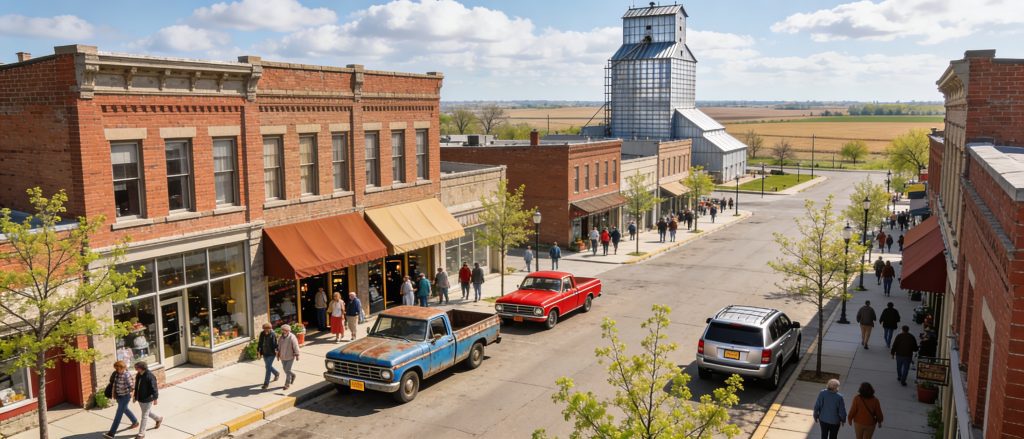
Welcome to the later 2020s. For many years now, especially in small towns and rural places, economic development looks a lot more ordinary—and a lot more interesting.
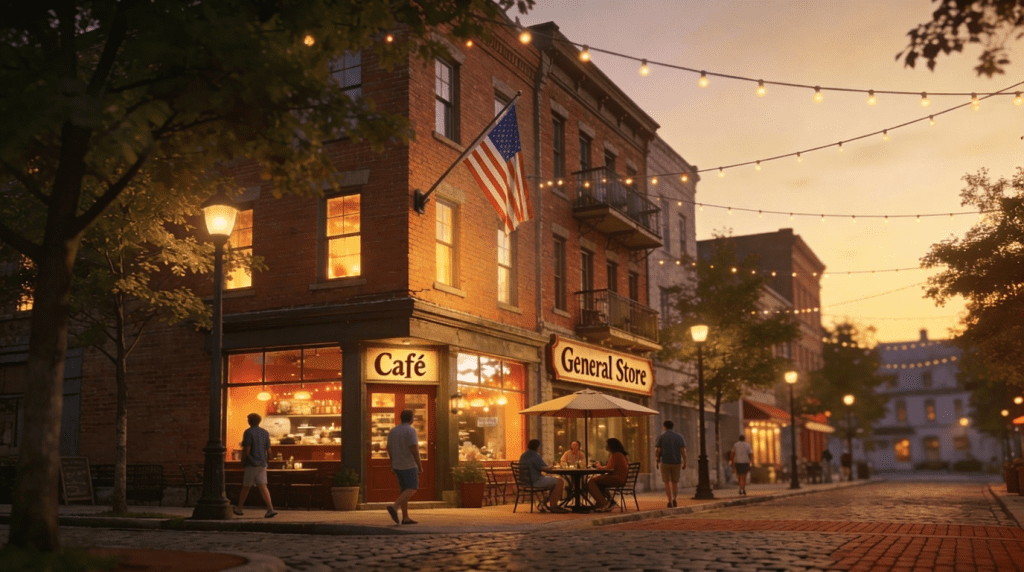
It looks like the city clerk wrestling with a grant portal on a Friday afternoon. It looks like a café owner who stays open late on Fridays so the new brewery down the block has somewhere to send hungry customers. It looks like neighbors arguing (politely, on a good night) over a comprehensive plan, then showing up again when it’s time to pour concrete.
Economic development today is more about building a place people want to be than bribing people to move places they have no intention of staying.
This post kicks off a month-long series on economic development here on JC Shepard(dot)com. We’re going to spend some time in the engine room: the often-unseen places where small towns and rural regions turn ideas into action, and action—if we’re lucky—into a little more prosperity and a lot more resilience.
What I mean by “economic development”
When I say “economic development,” I don’t mean a single office at city hall or the one person whose title happens to be “economic developer.” I’ve been that person and I didn’t do it sitting behind a desk all by myself.
When I say “economic development,” I mean the ongoing, collective work of neighbors, local leaders, and businesses to grow jobs and income, improve quality of life, and keep a community resilient over time.
Economic development work in the 21st century goes beyond recruiting businesses; it includes job creation, workforce training, infrastructure investment, and building more inclusive and resilient communities. Practitioners work to boost regional competitiveness and long‑term prosperity, especially in places facing high unemployment, low incomes, or other economic distress
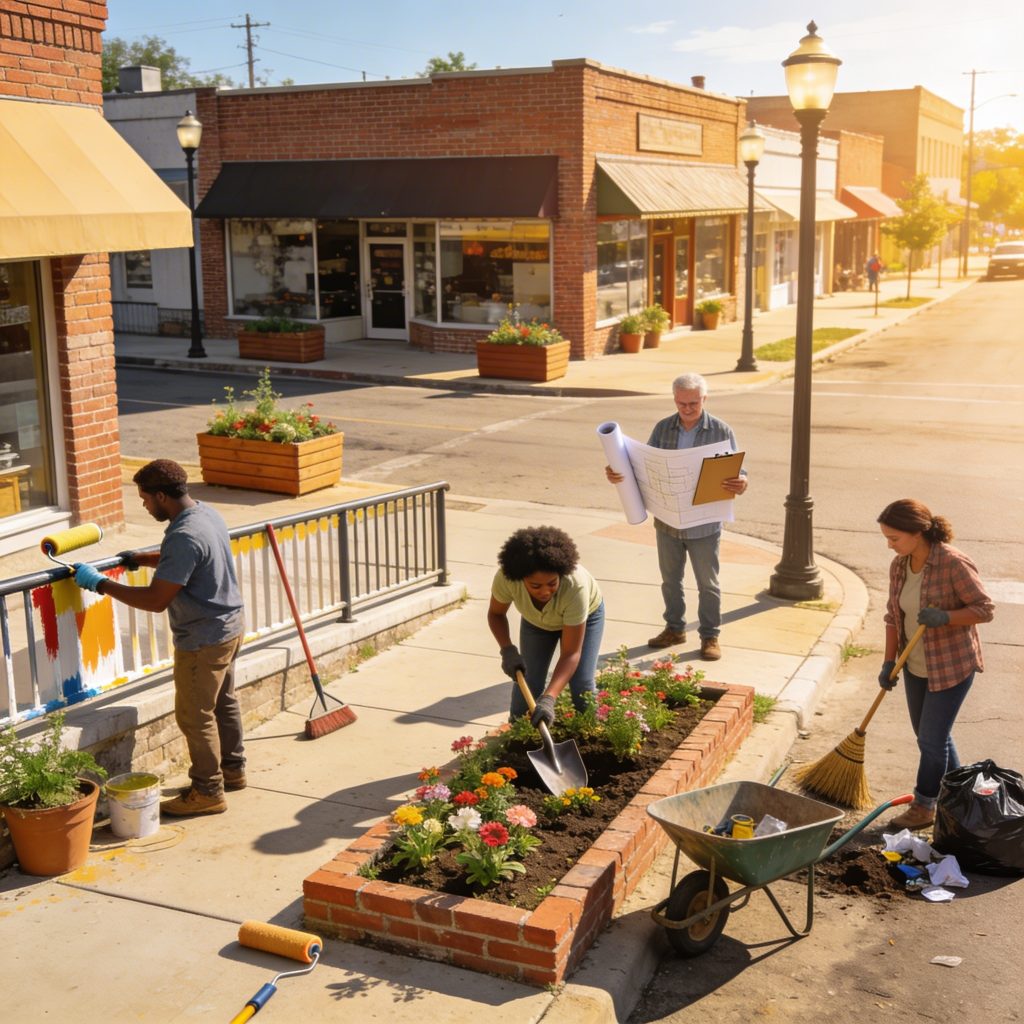
That work includes some very unglamorous verbs: assess, plan, repair, expand, retain, permit, finance, train, and maintain. It’s the county commissioner and the school superintendent and the banker and the Main Street volunteer all pulling on slightly different ropes, hopefully in roughly the same direction.
In my musings, I keep coming back to a few themes over and over:
- Sustainable rural economies.
Rural places are not miniature cities. They have their own economic typologies, linkages, and constraints. If you don’t understand how money really moves through your region, you’ll chase the wrong opportunities and miss the right ones. - Conservation and natural assets as economic engines.
Your river, your prairie, your forest, your grain elevator skyline—those are not just scenery. They’re part of your economic base, whether through agriculture, tourism, outdoor recreation, or simply the sense of place that keeps people rooted. - Housing and livability as economic infrastructure.
If people can’t find a decent place to live, or if the only apartments in town are older than the interstate, your “workforce problem” is actually a land use and housing problem. Employers know that; site selectors know that; residents know that.
Throughout this series, I’ll link back to some of these older posts that dig into those themes. Think of this introduction as the field guide, and the rest of the month as a walk through different habitats along the trail.
Who actually does the work?
Behind every grant award or new business sign, there’s an ecosystem of organizations and people. If you’re new to economic development—or even if you’ve been doing it informally for years—it helps to know who’s who.
Federal and national partners
At the federal level, the U.S. Economic Development Administration (EDA) is the part of the Department of Commerce focusing on economic development. EDA invests in planning, technical assistance, and infrastructure projects, and they recognize Economic Development Districts (EDDs) who help regions plan together instead of every city and county going it alone. The President’s budget has targeted EDA for elimination, and DOGE-driven staffing cuts have added uncertainty, but Congress so far continues to fund EDA and its core programs.
The US also has several regional quasi-federal or federal-state partnerships for economic development, although the practice is not as common as in Europe and some other nations. The Tennessee Valley Authority (TVA) is a federally owned corporation created in the New Deal to provide power, navigation, and flood control; over time it developed a robust economic development arm serving a seven‑state region. The Appalachian Regional Commission (ARC) is a federal–state regional commission covering 423 counties in 13 Appalachian states, created in 1965 to improve the economy and quality of life in a persistently poor region. Similar federally chartered regional commissions include the Delta Regional Authority (DRA), Denali Commission in Alaska, Northern Border Regional Commission, and others aimed at tackling structural regional disadvantages.
The National Association of Development Organizations (NADO) supports regional development organizations—many of them EDDs—with advocacy, research, and tools. If your region has a multi-county planning or development district, there’s a good chance they’re part of this network. When I worked at Southwest Regional Development Commission (SRDC) in Minnesota, my boss Jay Trusty was on the NADO Board of Directors for a while. Joe Barker, Executive Director of the Southwest Tennessee Development District (SWTDD), currently serves on the NADO board and hosts the Rural Strong Podcast. He invited me on the show as a guest recently to talk about rural development; that was a fun conversation.
Then you have the professional “big tent” association in the field. The International Economic Development Council (IEDC) is the primary professional association for economic developers across the country. It offers training, conferences, and a shared sense that you’re not the only person in America who thinks about industrial parks and tax increment financing on weekends. I was a member of the old American Economic Development Council (AEDC), before the merger with the Council for Urban Economic Development (CUED). This new group has come a long way from the old days of the one-trick pony of industrial recruitment.
I am a member of the American Planning Association’s Economic Development Division. The Economic Development Division’s mission is to advance the practice and state of the art of economic development planning by increasing the understanding of economic development as a key element of public policy at all levels of government, and to promote it as a critical element of the neighborhood, community, regional, and national planning process.
The National Rural Economic Developers Association (NREDA) is a professional membership organization focused exclusively on advancing rural economic and community development across the United States. NREDA emerged in the late 1980s, from a small group of folks in electric and telephone cooperatives came together to help co-ops market rural locations. Since then, the group has broadened in membership and focus. NREDA provides conferences, training, and other educational programming to encourage professional advancement, along with structured opportunities to exchange ideas and best practices among members. Lisa Hurley, who we have worked with in York County, Nebraska, is current NREDA Past President (she was President in 2025).
Universities and colleges are part of the story too. Groups like the University Economic Development Association (UEDA) work at the intersection of higher education and regional economies, turning research, extension, and workforce programs into real-world projects.
A Note on our Neighbors to the North
Canada, like many other advanced economies across the world, also has a plethora of professional economic development leaders and resources. Their duties and activities, as far as I am familiar, are fairly similar, yet I can’t speak from personal experience. The Economic Developers Association of Canada (EDAC-ACDE) is their national professional body.
State and professional associations
Each state typically has a state-level department of economic development (sometimes on its own, sometimes as part of a larger agency). Many utilities also have strong development programs of their own. Across the US, Tribes will typically have an economic development function, depending on resources and local culture.
At the state level, economic development professionals rarely operate alone. Associations like WEDA—the Wyoming Economic Development Association, the Washington Economic Development Association, or the Wisconsin Economic Development Association (all WEDAs, in different time zones) give practitioners a place to compare notes, build skills, and show a united front at the legislature.
When I returned to North Dakota after grad school, other professionals in the state economic development organization (then called the Industrial Development Association or IDA) showed great mercy and understanding on this young know-it-all. Not only did I learn so much at conferences and training, but I also benefitted from mentors with more patience than I have. Melissa Beach, one of my successors at Traill County EDC who has since moved up in the world, currently serves as President of EDAND.
As my firm is based in Nebraska here, I am a member of the Nebraska Economic Developers Association (NEDA). The Nebraska Industrial Developers Association updated their name in 1992. NEDA provides opportunities for member training and education, and during the legislative session keeps an eye on the Unicameral Legislature and keeps us members updated in detail. Lisa Hurley from York County, Past President of NREDA, currently serves as Secretary on the NEDA Board.
If you’re working in local government or on a board, these state associations can be a great way to plug into the wider field, understand emerging tools, and make sure your town isn’t re-inventing the wheel.
Regional and local organizations
For most small towns, the most important players sit closer to home.
As I’ve mentioned, regional councils and Economic Development Districts stitch together multiple counties. They help write the regional Comprehensive Economic Development Strategy (CEDS), keep up with federal and state grants, and run programs an individual rural county would struggle to manage on its own. They also tend to provide basic technical assistance to prime the pump until a community can afford to bring in a professional consultant or project developer. They really are jacks-of-all-trades.
At the local level, you’ll see economic development corporations (EDCs), city or county economic development offices, chambers of commerce, downtown organizations, and a rotating cast of task forces and steering committees. Throw in consultants and academics and stir well. Some are professional staff; some are entirely volunteers. Together, they typically handle:
- Business retention and expansion (BRE) visits
- Facilitating entrepreneurship and growing new markets
- Managing revolving loan funds
- Organizing community events and “shop local” campaigns
- Ombudsmen services to help folks through zoning, permitting, or incentive programs
- And yes, marketing sites and buildings—you need space if you’re going to grow
I have worked in economic development throughout my career; however, only in my first job out of grad school did my employer have the formal title. In the 1990s, I was Executive Director of the Traill County Economic Development Commission, a Jobs Development Authority then located on the campus of Mayville State University in North Dakota. Since then, the EDC office was moved to the county seat at Hillsboro, on Interstate 29 between Fargo and Grand Forks. I had a great volunteer Board of Directors representing each corner of this farming community in the rural Red River Valley of the North. We did a lot of work on new enterprises, some of which made it to start-up phase, as well as existing business retention and expansion, and infrastructure development—this was back in the day when our on-ramp to the information superhighway was a long-distance call on a squawk-box modem. Most of our work was in partnership with local development groups in the larger municipalities and regional partners in North Dakota and across the river in Minnesota.
Nebraska
My current home town is served by the Southeast Nebraska Development District (SENDD), a voluntary regional association of counties and municipalities focused on community, economic, and housing development across a 16‑county area. SENDD is based in Lincoln, Nebraska, and serves as one of eight economic development districts across the state. Executive Director Tom Bliss currently serves on the NADO Board of Directors.
SENDD’s stated mission is to identify common regional problems, coordinate solutions, and provide continuing support for efficient and effective local government among its members. The organization emphasizes place‑making, using projects that support local businesses, job creation, affordable and safe housing, education, health, recreation, and public spaces that promote health, happiness, and well‑being.
Within Nebraska’s EDD system, districts like SENDD support local planning, grant writing, housing programs, business finance, and regional project coordination, and collectively have leveraged tens of millions of dollars in infrastructure and development investments statewide. I mentioned SENDD’s housing programs in last week’s post on rural housing.
SENDD’s economic development program specifically supports:
- EDA and USDA revolving loan funds
- Technical assistance for business startups and expansions
- Leadership program certifications sponsored by the State of Nebraska
- Economic development training and tool kits.
Local economic development organizations are essential partners in our long-range comprehensive planning projects, as well as redevelopment and housing programs. As I mentioned last week, the Thayer County Economic Development Alliance, for example, partners with SENDD on funding for housing, as well as Thayer County’s more traditional economic development programs.
At the City of Burwell, Nebraska (year-round population ~1,000), the Economic Development Director Jessica VanDeWalle played essential role in our Comprehensive Planning and Zoning update project, which included a new Strategic Plan and Capital Improvements Plan (CIP). That project was recognized by the Nebraska Chapter of the American Planning Association (APA) and the APA Small Town & Rural Planning (STaR) Division in 2025—all due to local community engagement. Strategic investments in childcare, housing, tourism, and community development in the Garfield County seat have also earned recognition from the State of Nebraska.
Next door, the Valley County Economic Development (VCED) Board serves as the lead organization for economic growth and development in Valley County, Nebraska (population ~4,000). The county seat of Ord, Nebraska, is the state’s first Certified and re-Certified Economic Development Community. VCED has worked to catalyze economic growth in area communities. Executive Director Caleb Pollard brings a mix of public and private-sector experience to hand—yes, he is a successful entrepreneur himself at Scratchtown Brewing Company. Valley County’s economic development organization provides comprehensive information about doing business in the area, provides assistance to existing businesses, new business start-ups, and people relocating to the area, as well as facilitating financial incentives and packaging. Caleb has also been diligently working on housing issues, including home repairs and opening lots for new buildings.
These are but a sampling of local economic development efforts—your results will vary.
How Economic Development Shows Up in Small Towns
Most of the time, economic development doesn’t feel like a special event. It feels like work.
It’s the long process from “we should do something about that” to a real project with funding, partners, and an end date. Sometimes the “something” is fixing a crumbling block downtown; sometimes it’s developing a new business park; sometimes it’s as simple—and as complicated—as making sure your one childcare provider doesn’t close.
In my experience, a few key tools keep turning up in successful small-town efforts:
- Asset-based development.
Start with what you have: your history, your landscape, your local makers and musicians and storytellers. That’s not nostalgia; that’s economic positioning. The places that do this well lean into their Americana, not away from it. - Business retention and expansion.
Most new jobs in your region will come from the businesses already on the ground, not the ones you hope to recruit someday. Systematic BRE—actually checking in with employers, tracking their needs, and being responsive—is the unglamorous foundation of rural economic development. - Entrepreneurship and the “creative economy.”
In many small towns, the most interesting economic stories are happening in second-story studios, on kitchen tables, and in side-hustles that grow into real companies. Supporting these entrepreneurs with space, networks, and small amounts of capital can have outsized impact.
None of these tools is new. What makes them powerful is the way they’re combined and sustained over time. We’ll discuss more about each through this month’s series of blog posts.
A Note on the Game of Industrial Recruitment
While I dismiss the idea of industrial recruitment in general, the Original tactic of economic development is still very much in vogue in certain circles. If you’re a State or a Big City with a ton of money to waste, well good for you. The places I live and work don’t have resources to gamble away.
In my humble opinion, industrial recruitment is gambling. Like playing poker, every so often you get lucky (especially if you can count cards). Some people just like to gamble for the fun of it, like golf or driving the North Freeway in Houston. The odds are not in your favor.
Economic Development Data
When it comes to data for economic development, there are a lot of different sources out there. We talked about some of these in last month’s article on demographics:
- US Census Bureau’s American Community Survey’s rolling five-year averages cover every county and municipality across the United States, providing a range of demographic and socioeconomic data.
- US Census Bureau County Business Patterns (CBP) provides annual data on establishments with paid employees, including employment during the week of March 12, first quarter payroll, and annual payroll by industry and employment size.
- BLS Quarterly Census of Employment and Wages (QCEW) is the most comprehensive source of county-level employment data, covering more than 95% of US jobs.
- BLS Local Area Unemployment Statistics (LAUS) produces monthly and annual employment, unemployment, and labor force data, though some states provide better local coverage.
- BEA Personal Income by County data set is a more comprehensive annual estimate of personal income; however, BEA has recently discontinued many data reports covering rural counties.
- USDA Economic Research Service (ERS) provides county-level data sets which compile socioeconomic indicators including poverty rates, population change, unemployment rates, and median household income.
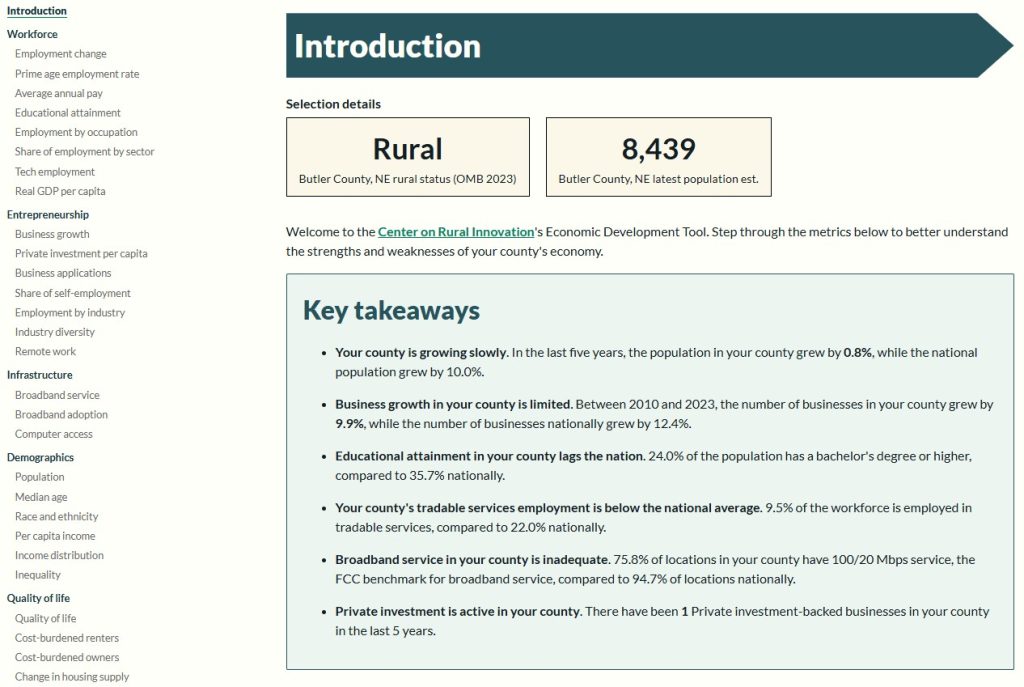
The Center on Rural Innovation (CORI), a nonprofit focused on closing the rural opportunity gap, recently released a Rural Economic Development Toolkit, specifically as a resource for rural America. Let’s take my neighborhood in Butler County, Nebraska, as an example.
- Butler County employment is up 2% from 2019 (pre-pandemic), compared to a 4% gain in Nebraska statewide and 5% gain across the US.
- $54,326 Average Annual Pay, compared to $61,050 across Nebraska and $75,585 for the US (QCEW)
- 78.7% prime age employment rate, down from 85.4% in 2019; compared to 84.5% in Nebraska and 78.8% nationwide at fairly stable rates.
- 24.0% college educated—educational attainment is a proxy for skill levels, yet may not capture the value of practical skills important for the trades. Nebraska’s share of population with a bachelor’s degree or higher stands at 34.6% compared to the national level of 35.7%.
These are sample indicators which inform strategies for asset-based economic development. We can work to improve statistics, say through workforce training and opening access to community colleges in small towns. Or we can adapt our development approach to the skills and priorities of the people who already live in our communities. A mix of both is probably best.
Edit: I should have also highlighted Headwaters Economics’ Economic Profile System as another easy aggregator of social and economic data. I’m a long-time fan.
What This Series Will Cover
Over the next month, I want to unpack these ideas in a way that’s useful whether you’re a planner, an elected official, a volunteer on the local EDC board, or just someone who cares about your town’s future.
Here’s where we’re headed:
- Post 1 (today!): What economic development really looks like in small towns and rural regions—beyond the stereotypes.
- Post 2: Understanding your rural economy—jobs and income and why headlines never tell the whole story.
- Post 3: Entrepreneurship, retention and expansion as economic strategy, not side issues.
- Post 4: Housing and quality of life as economic development issues—follow-up and expand on our February and March themes.
- Post 5: We have an extra weekend in March this year, so we’ll see where the bonus post goes as we transition to community facilities come April.
Each post will aim to give you at least one concrete takeaway: a checklist, a question set to use in your next meeting, or a simple tool you can adapt locally.
An Invitation to the Economic Development Engine Room
Economic development, as I use the term here, is part of a larger story—life, liberty, and the pursuit of a better quality of life. It’s about how real places adapt over time, and how people hang on to what matters while still making room for what’s next.
If you’re in the middle of this work—even if you don’t call it “economic development” on your business card—I’d like this series to be a conversation, not just a monologue. I’ll bring examples, tools, and a bit of theory. You bring your questions, your wins, and your frustrations.
What’s one economic development win—or one stubborn problem—from your town this year? I’d love to hear about it. Drop a comment, send a note, or find me where you usually see JC Shepard(dot)com pop up in your feed.
Then, let’s get to work.
Resources
Books
- Abundance by Ezra Klein and Derek Thompson (Avid Reader Press / Simon & Schuster, 2025). NOT an endorsement, but a sample of the zeitgeist.
- Proudly Made: A Memoir by Tataboline Enos (Catamount Press, 2025). YES, an endorsement, even though this is not strictly an economic development book, Ta offers some profound insights on life and the economy of rural America.
- The New Geography Of Jobs by Enrico Moretti (Houghton Mifflin Harcourt, 2012)
- The Community Economic Development Handbook: Strategies and Tools to Revitalize Your Neighborhood by Mihailo Temali (Fieldstone Alliance, 2002)
- The Nature of Economies by Jane Jacobs (Random House Canada, 2000)
- Cities and the Wealth of Nations: Principles of Economic Life by Jane Jacobs (Random House, 1984)
- The Economy of Cities by Jane Jacobs (Vintage / Ebury, 1970)
Links
- US Economic Development Administration (US EDA): https://www.eda.gov
- National Association of Development Organizations (NADO): https://www.nado.org
- International Economic Development Council (IEDC): https://www.iedconline.org
- APA Economic Development Division: https://economic.planning.org
- National Rural Economic Developers Association (NREDA): https://www.nreda.org
- University Economic Development Association (UEDA): https://www.universityeda.org
- Economic Developers Association of Canada (EDAC-ACDE): https://edac.ca
- Nebraska Economic Developers Association (NEDA): https://www.neda1.org
- Southwest Regional Development Commission (SRDC) Minnesota: https://www.swrdc.org
- Southeast Nebraska Development District (SENDD): https://sendd.org
- Southwest Tennessee Development District (SWTDD): https://swtdd.org
- The Center on Rural Innovation (CORI) Rural Economic Development Toolkit
More from JCShepard(dot)com
2026: Bring Your Plans to Life – Monthly Themes Preview
Join me on the RuralStrong Podcast (Season 1 Episode 36) on Youtube (audio), Spotify, and Apple Podcasts (February 2026)
- Reviving Rural America: Why Heritage Tourism Is a Game-Changer Now (September 2025)
- How Small Towns Succeed: A Proven Playbook for Rural Action (November 2025)
- The Rural Comeback: How Small Town Innovation Sparks Growth (August 2025)
- How Small Towns Can Build a Strong Outdoor Economy Without Selling Out (June 2025)
Check out The 12 Planning & Sustainability Books You Need in 2026 and browse through the Small Town & Rural Community guides on our Resources page.
(As an Amazon Associate, we may earn commissions from qualifying purchases. Check your local library or bookshop, too.)
.